Get Full Government Meeting Transcripts, Videos, & Alerts Forever!
Get email alerts on the Carshare Pilot topic
No spam. Unsubscribe anytime.
SFMTA presents year‑long evaluation of on‑street car‑share pilot as neighbors press for controls
Summary
The SFMTA told supervisors its on‑street car‑share pilot, studied April 2015–April 2016, placed about 200 curbside car‑share spaces and recorded an average of 19 unique users per month per space; supervisors and residents pressed the agency on notice, equity, RPP interactions and Getaround’s peer‑to‑peer model.
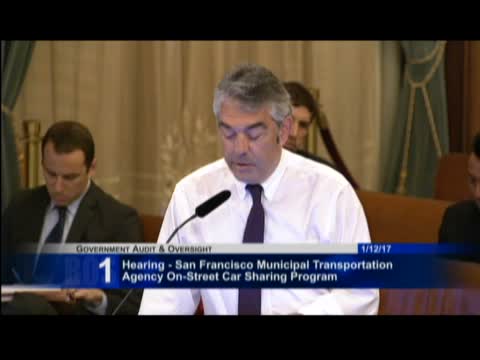
The San Francisco Municipal Transportation Agency told the Board of Supervisors’ Government Audit & Oversight Committee on Jan. 12 that its on‑street car‑share permit pilot placed roughly 200 curbside spaces across the city and used April 2015–April 2016 as the primary analysis year.
Andy Thornley, of the SFMTA’s Sustainable Streets division, said the agency initially tested 12 spaces in 2011, expanded with a board‑approved pilot in 2013 and reached about 200 spaces on the ground by April 2015. The pilot qualified three operators—City CarShare, Zipcar and Getaround—and required participating providers to share usage data with the SFMTA. Thornley said the average on‑street car‑share space had about 19 unique users per month; some high‑performing spaces recorded more than 50 unique users monthly.
The pilot used a zone structure to encourage placement beyond central neighborhoods: the agency required participating providers to locate at least 15 percent of their spaces in each of two outer zones to spread service citywide. The MTA said the pilot was CEQA‑cleared for as many as 900 spaces over its life but deployed about 200 for the evaluation period.
Committee members and public commenters raised several operational concerns. Chair Erin Peskin said residents in District 3 had frequently asked why on‑street curb spaces were being removed from residential parking and why neighborhood notice felt inconsistent with other city processes. Thornley acknowledged outreach fell short in places and committed to better notification when the agency recommends a final program.
Supervisors and residents focused attention on the peer‑to‑peer provider Getaround. Peskin and multiple witnesses said they had heard complaints that some neighborhood residents were using numerous Residential Parking Permits (RPPs) to host a small commercial‑style fleet, reducing parking availability for neighbors. Thornley said the MTA set a 75 percent minimum shared‑availability condition for permits in the pilot but acknowledged that the threshold and enforcement would need refinement in any permanent program.
Equity and accessibility were also front and center. Thornley said the agency lacked a ready solution for wheelchair‑accessible shared vehicles or options for unbanked residents, noting City CarShare had previously offered modest programs for low‑income and disabled members. He told the committee the MTA is consulting academics and peer cities to develop stronger equity requirements.
Neighborhood groups asked the MTA to audit specific sites where dedicated car‑share spaces appeared frequently occupied yet not available for booking, citing examples such as Hyde & Green. Thornley said the pilot’s data sharing allowed the MTA to analyze “space‑by‑space” performance and that the forthcoming full evaluation—scheduled for publication next week—would provide detailed logs and hearings history.
Thornley said the MTA will present recommendations to its policy and governance committee and expects to return to the full board with a proposed operational program in the following months. Until the board adopts a permanent program, he said, the on‑street spaces remain part of a pilot and could be undone if the board directs.
The committee asked the MTA to provide neighborhood notice improvements, clearer rules about RPP interactions and proposals to ensure social equity and accessible vehicles before any permanent program is recommended.