Get Full Government Meeting Transcripts, Videos, & Alerts Forever!
Get email alerts on the Millennium Tower topic
No spam. Unsubscribe anytime.
San Francisco committee presses DBI over Millennium Tower reports, peer review and notices of violation
Summary
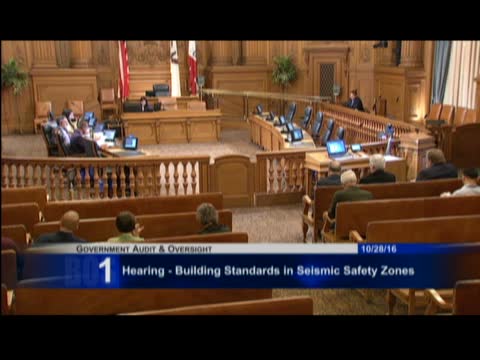
At a special Government Audit and Committee hearing, supervisors pressed the Department of Building Inspection over differences between earlier and final consultant reports on the sinking Millennium Tower (301 Mission), announced notices of violation, and sought an independent peer review panel; staff said a panel is being empaneled and developer-paid funds will be held by DBI to contract reviewers.
Supervisor Aaron Peskin opened a special hearing to continue oversight of the Millennium Tower (301 Mission), saying new information shows the high-rise has sunk substantially and is tilting and urging the Department of Building Inspection (DBI) to pursue independent technical review and greater transparency. ‘‘I was, quite disappointed with the lack of transparency, document retention policies, and follow-up from our department of building inspection,’’ Peskin said during the session.
DBI Director Tom Huey told the committee the department’s priority is public safety and property protection and described steps under way: an internal review, empaneling an independent peer review group to assess consultant reports, and changes to procurement so developers pay DBI, which would in turn fund and direct payments to an independent peer-review panel. ‘‘Our department… the goal is to make sure to protect safety of the public and also property,’’ Huey said.
The committee focused on differences between a 2014 draft and a 2016 final technical report by Mr. Hamburger (referred to in testimony as the ‘‘Hamburger report’’). DBI principal engineer Hansen Tom told the committee the 2014 draft contained specific remedial recommendations—such as reinforcing the foundation mat and adding concrete walls below basement levels—that do not appear in the 2016 final report. Hansen said the final relied heavily on complex computer modeling and that the analysis needs independent verification.
Peskin and other supervisors pressed staff about DBI authority and past practice. Peskin cited earlier filings showing the building had already settled more than eight inches by February 2009 and said at least some remedial recommendations were removed in the later report. DBI staff described constraints created by code distinctions between ‘‘code-prescriptive’’ and ‘‘performance-based’’ designs and said their power to require third-party peer review depends on specific code provisions and administrative bulletins.
Bill Strachan, DBI legislative and public affairs, said DBI has also started a records-retention policy to keep engineering letters tied to tall building projects with inspection records that are more retrievable and viewable by staff and the public. Strachan said the department received a packet of documents on Sept. 28 that totalled roughly 140 files and nearly 4,000 pages and that those materials will be provided to the peer review group.
Committee members asked about timing for the external review. Staff estimated the peer review will occur once an independent panel is empaneled and suggested two to four weeks after empanelment as a working estimate. Peskin introduced a $250,000 supplemental appropriation to fund independent consultants to advise the Office of Emergency Management and DBI on design standards and said he has introduced legislation to form a seismic safety advisory group modeled after UC Berkeley’s tall building initiative.
DBI staff also described recent enforcement: the department issued notices of violation related to noncompliant building features and identified an entrance ramp that has become steeper as the building settled, rendering it not ADA-compliant. Deputy Director Dan Lowry told the committee the existing handrails indicate ramps existed at the time of construction but the slope has increased and that some repairs or alterations were done without permits.
Former DBI deputy director Raymond Louie and DBI staff recounted prior involvement with Transbay/JTPA peer-review meetings and said settlement at Millennium Tower was discussed during earlier reviews. Sweeney, a DBI official, told the committee the department relied on letters from the project’s engineers of record and that DBI granted the Certificate of Final Completion after special inspections for life‑safety items passed.
A resident of 301 Mission, Frank Jernigan, testified that occupants have seen cracking and interior changes and described a demonstration video showing a marble rolling on a tilted floor; he asked what the city can do to compel the developer to fix the problem now.
What’s next: DBI said it will continue assembling an independent peer review panel working with the chief administrator’s office, provide source data to reviewers, and report back to the committee; supervisors signaled they will pursue the supplemental appropriation and the seismic safety advisory group legislation.
Provenance: Topic appears in committee item reading and discussion beginning with Item 1 (SEG 020) through the end of the public hearing portion (SEG 1645).