Get Full Government Meeting Transcripts, Videos, & Alerts Forever!
Get email alerts on the Housing topic
No spam. Unsubscribe anytime.
Mayor proposes bonding against Housing Trust Fund to accelerate affordable housing; MOHCD outlines modest two-year production
Summary
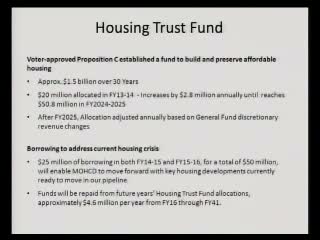
MOHCD told the committee the mayor proposes borrowing against future Housing Trust Fund allocations to put $25 million per year into capital for affordable housing, aiming to jump-start several developments and support a pipeline that MOHCD estimates could deliver roughly 2,400 affordable units over four years when combined with other programs.
The Mayor's Office and the Mayor's Office of Housing and Community Development appeared before the Budget and Finance Committee on June 16 to outline a housing-focused budget that uses the Housing Trust Fund to accelerate affordable housing production.
Kate Howard, the mayor's budget director, said the mayor's proposed budget places strong emphasis on affordable housing, with roughly 82 percent of the mayor's office resources directed to housing and community development programs. She described a new Office of Strategic Partnerships to cultivate public-private initiatives; that office is budgeted at about $581,000 in the first year, largely supported by private philanthropic commitments.
Olson Lee, Director of MOHCD, explained a plan to borrow against future Housing Trust Fund allocations so the city can make larger capital commitments now. The Housing Trust Fund was approved by voters to provide roughly $1.5 billion over 30 years; MOHCD said it proposes advancing $25 million in each of the two budget years into the capital budget, to be repaid over the life of the trust fund. Lee said those funds will underwrite requests for proposals to support up to four new sites and to seed programs including a small-sites acquisition initiative intended to preserve smaller, at-risk affordable buildings.
Lee described how the plan fits into a broader pipeline: MOHCD estimates the office will initiate roughly 800 new-construction affordable units over four years and will support rehabilitation of about 3,500 housing authority units under the Rental Assistance Demonstration (RAD) over a similar period. With redevelopment-area contributions (OCII) and inclusionary units, MOHCD's estimate of total affordable units tied to the city's combined efforts was characterized as a multi-thousand-unit pipeline, though supervisors pressed officials about speed and scale.
Supervisors raised concerns about the pace at which units come online and emphasized preservation of existing affordable units. MOHCD said the small-sites program and RAD repositioning are intended to accelerate production and preservation, but officials acknowledged many pipeline aspects depend on project-level timelines and the broader construction market. Budget analysts noted recommended reductions and policy considerations for future Certificates of Participation issuance and placed proposed COPs on controller reserve pending sale.
The committee received the presentation and expected follow-up deliberations about policy approvals for bonding and CIP appropriations prior to final budget votes.