Get Full Government Meeting Transcripts, Videos, & Alerts Forever!
Get email alerts on the Millennium Tower topic
No spam. Unsubscribe anytime.
Supervisors Question DBI’s Oversight After Millennium Tower Found to Have Settled and Tilted
Summary
The Board of Supervisors’ Government Audit & Oversight Committee held a hearing after reports that Millennium Tower had settled far more than projected and begun tilting. DBI officials described historic reliance on owner‑provided engineering reports, pledged protocol and records-review changes, and the committee continued the item for further review within one month.
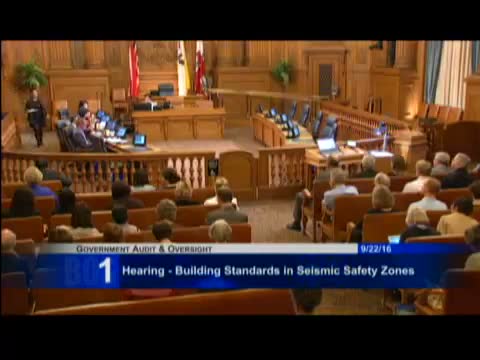
SAN FRANCISCO — The Board of Supervisors’ Government Audit & Oversight Committee convened a special hearing on Sept. 22, 2016, to examine why the 58‑story Millennium Tower in the Transbay area has settled far more than engineers originally projected and what the city knew about the problem.
Chair Aaron Peskin opened the hearing saying the committee would “identify who knew what, when they knew it, and what they did about it,” after press reports that the tower had settled roughly 16 inches — well beyond the 4–6 inches originally anticipated — and had developed a two‑inch tilt to the northwest. He noted documents produced by third parties indicate the developer and consultants recorded larger settlement years earlier.
The Department of Building Inspection’s director, Tom Huey, and DBI staff told supervisors that DBI has launched an investigation and asked the building’s owners for records, but stressed the department traditionally relies on engineering reports submitted by owners and their consultants. Ron Tom, DBI’s assistant director, described the department’s role as reviewing plans and conducting inspections to verify construction conformed to approved plans and codes; he said DBI’s field inspectors did not observe “obvious” visual signs of settlement during routine inspections from 2006 through 2009.
DBI staff provided project facts: Millennium Tower is a concrete, 58‑story residential building with about 420 units, a reported project valuation around $175,000,000, foundation piles driven roughly 66–91 feet, and temporary certificates of occupancy issued in March and May 2009 with final occupancy in August 2009. Hansen Tom, DBI’s principal engineer, described early peer‑review practice development and recounted a high‑pressure review of a proprietary reinforcement system (the “bow‑grip”) that led to prototype testing at UC Berkeley before DBI approved its use.
Several supervisors pressed DBI about a Feb. 2009 memorandum from then‑deputy director Raymond Louie that asked eight questions of the developer and consultants about observed settlement and differential movement. Louie testified that he recalls receiving information that the building was settling and that responses at the time acknowledged additional settlement and monitoring and projected final settlement nearer 12 inches. Supervisors said they found gaps in DBI’s files and asked why follow‑up actions, peer reviews or independent verification do not appear to be documented. DBI witnesses acknowledged record‑keeping problems and said they will revisit record retention and internal communications protocols.
Patrick Otellini, the city’s chief resilience officer, told the committee his office is overseeing the 30‑year earthquake safety implementation program and said there are opportunities to strengthen standards for new construction so buildings are more quickly re‑occupiable after a major quake. Otellini cited studies suggesting modest cost increases in new construction could substantially improve post‑earthquake habitability.
Homeowners and the building association’s counsel told the committee they had uncovered documents that indicate certain parties knew about excessive settlement years earlier and that homeowners had not received disclosures about settlement. Yvette Davis, retained to assist the Millennium Tower Association, said the association will commission independent engineering analyses and cannot realistically produce a full report within 30 days, as DBI requested.
Chair Peskin said the committee’s work would continue and moved to continue the item to the call of the chair and to reconvene no later than one month, which the body adopted. No formal vote tally was recorded on the motion during the hearing record.
What the committee requested and what comes next
The committee asked DBI to return with revised policies on record retention and internal communication protocols within about a month and signaled it will hold subsequent hearings to examine whether DBI should require independent verification or stronger peer‑review triggers for foundation and geotechnical reports on large, downtown high‑rise projects. The immediate formal action taken at the meeting was to continue the item to the call of the chair and schedule another hearing within a month.
Why this matters
Supervisors framed the issue as both a governance and safety concern: if the city became aware years ago that a new downtown residential tower was not performing as predicted, the board said it needs clearer protocols to ensure timely review, independent verification where warranted, and transparent disclosure to potential purchasers and residents. Homeowners urged expedited action to protect life‑safety systems and minimize risks to occupants and neighboring infrastructure.
The committee adjourned after continuing the item; staff said witnesses and DBI officials will return with additional materials and proposed policy changes at forthcoming hearings.