Committee advances fire‑code rules for lithium‑ion batteries and powered mobility devices
Loading...
Summary
The committee voted Jan. 29 to recommend as amended an ordinance establishing charging, storage and device standards for e‑bikes, scooters and other powered mobility devices, prohibiting use of damaged or reconditioned batteries except as part of authorized recycling, and requiring a public information campaign coordinated with the Department of the Environment.
The Land Use & Transportation Committee on Jan. 29 voted to forward an amended ordinance to the Board of Supervisors that would tighten fire‑code standards for the charging and storage of lithium‑ion batteries used in powered mobility devices — including e‑bikes, scooters, skateboards and hoverboards — and launch an informational campaign on safe use and disposal.
President Aaron Peskin, a lead sponsor, cited an increase in battery fires over several years and a recent fatality in San Francisco as motivation for the ordinance. Fire Marshal Ken Coughlin outlined key provisions: a requirement that devices be "safety certified" (UL, European EN standards, or an accredited lab approved by the fire department), limits on the number of personal devices allowed inside dwelling units unless they are listed devices, a prohibition that unlisted or unknown devices be charged indoors (unlisted devices must be charged outdoors), business charging requirements (mechanical ventilation and receptacles, fire suppression if charging many units), inspection of damaged batteries, and a ban on the sale or reuse of reconditioned batteries except by city‑authorized recycling and accredited businesses.
Public comment: Dozens of speakers — tenants' groups, resident witnesses of past battery fires, the San Francisco Bicycle Coalition, small business and retail representatives, public‑safety advocates and the firefighters' union — generally supported the ordinance while urging refinements. Concerns raised included clarity on charging in private garages, the logistics and cost of the 3‑foot spacing rule for chargers, standards for small custom builders (suggestions to reference battery‑centred UL standards), and how a trade‑in or rebate program for unsafe devices would work. The Department of the Environment will co‑lead the public outreach campaign and contribute recycling strategy.
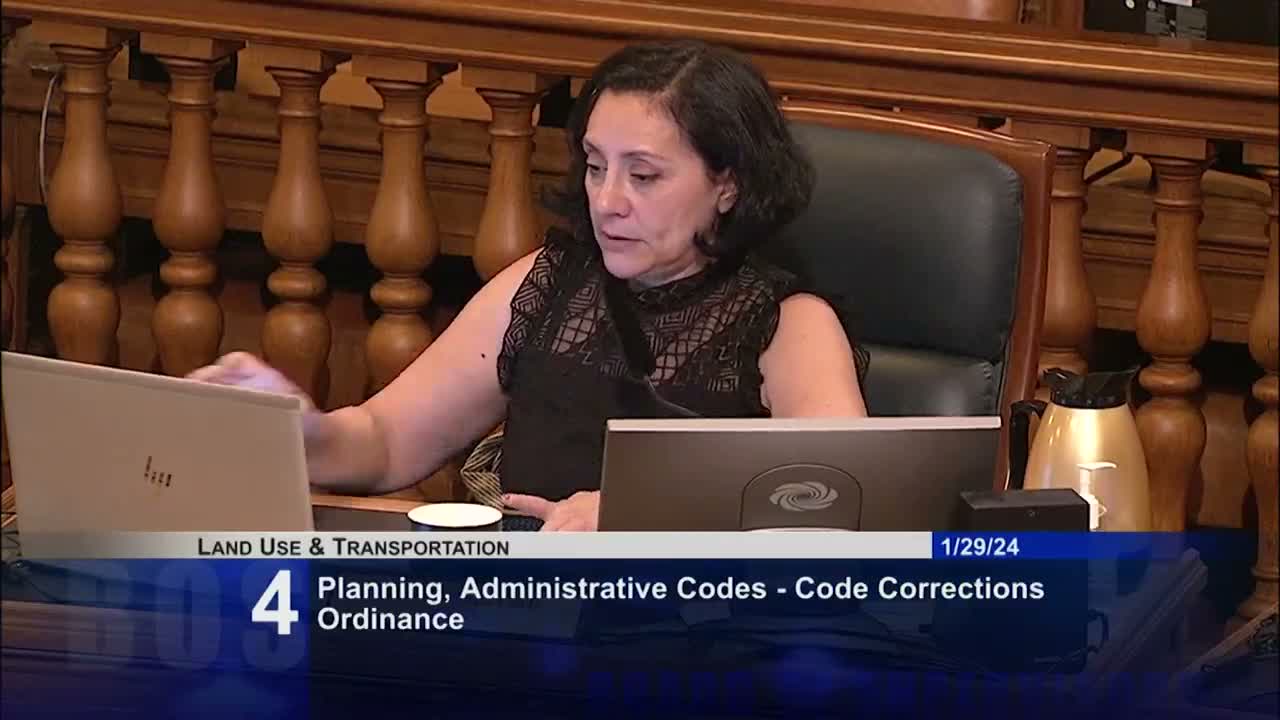
Committee action: President Peskin moved a package of non‑substantive amendments (definitions, citations to California hazardous‑waste regulations, direction to explore a trade‑in program, clarifying the safety‑certified device definition and authorized recycling language) and the committee voted to recommend the ordinance to the full Board as amended (Preston—Aye; Peskin—Aye; Melgar—Aye).
What happens next: The ordinance and amendments will be presented to the Board of Supervisors for consideration.