Get Full Government Meeting Transcripts, Videos, & Alerts Forever!
Get email alerts on the Mental Health topic
No spam. Unsubscribe anytime.
Supervisors hear push to enact Laura’s Law in San Francisco after local and out‑of‑county results
Summary
Supervisor Mark Farrell introduced legislation and a ballot measure to bring assisted outpatient treatment ("Laura's Law") to San Francisco. Speakers — including Mayor Ed Lee, the Wilcox family and clinicians — cited Nevada County and New York evidence of reduced hospital days, arrests and homelessness for high-need patients. (298 characters)
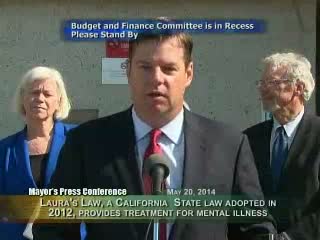
Supervisor Mark Farrell introduced legislation and a proposed November ballot measure to implement Laura’s Law — a form of assisted outpatient treatment (AOT) for people with severe mental illness who are repeatedly unable to engage in voluntary care — and assembled local health and public-safety leaders and family advocates to make the case.
Farrell described case histories of family caregivers who lose contact with adult children whose severe mental illness causes them to deteriorate. He said Laura’s Law would provide a civil court‑ordered pathway to engage people in treatment earlier and prevent crises.
Amanda and Nick Wilcox, parents whose daughter Laura was killed in a 2001 incident that led them to champion the statute, told the committee of the damage produced by waiting for crises. Amanda Wilcox recounted their efforts in Nevada County, which implemented AOT in 2008, and described outcomes the county and researchers attribute to the program’s collaborative court-treatment model.
Clinicians who treated similar populations testified about the clinical phenomenon anosognosia — lack of insight into disease — that leaves some people unable to recognize the need for care. Dr. John Rouse, a UCSF psychiatrist, said the eligible local population is relatively small but that those individuals are high users of emergency services and are frequently incarcerated or chronically homeless. “With Laura’s Law in place, we would hope to see a reduction in PES visits, the acute hospitalizations, and the arrests,” Rouse said.
Speakers cited Nevada County results and Kendra’s Law outcomes from New York as evidence of reduced hospital days, fewer incarcerations and net cost savings. Barbara Garcia, director of DPH, said the department has capacity to establish an AOT outpatient program and highlighted the need for family and provider access tools to engage individuals earlier.
Supervisor Farrell said he will pursue legislation at the Board and, if necessary, a ballot measure to give voters a direct decision. The committee recorded testimony and pledged follow-up with DPH and other stakeholders about implementation logistics and costs.