Get Full Government Meeting Transcripts, Videos, & Alerts Forever!
Get email alerts on the Transportation topic
No spam. Unsubscribe anytime.
MTA defends budget tie to November measures; Sunday parking enforcement set to end July 1 if approved
Summary
SFMTA Director Ed Reiskin told the supervisors the agency's operating and capital plans rely on November ballot measures — a $500 million bond and restoration of the vehicle license fee — that would, if approved, fund service increases, Muni Forward projects, WalkFirst and Vision Zero work; the MTA board unanimously approved removing Sunday parking meter enforcement, slated to end July 1 if enacted.
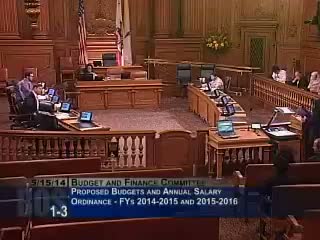
Ed Reiskin, director of the San Francisco Municipal Transportation Agency, presented the MTA's two-year operating and capital outlook, emphasizing equity, service improvements and the agency's dependence on proposed November ballot measures to fund major investments.
Reiskin said Muni averages more than 700,000 weekday boardings and serves many low-income and transit-dependent riders. He described a newly formalized equity framework adopted by the MTA board that compares neighborhood-level performance (on-time reliability, crowding, travel times, and customer satisfaction) to the system average and uses those comparisons to prioritize corrective actions and capital investments.
On operations, the proposed budget funds a phased 10% service increase over two years and continues fare indexing under board policy. Reiskin noted a planned 3% transit fare increase in year one and an expansion of free Muni for low- and moderate-income youth to age 18, funded by a Google gift. Sonali Bose, MTA staff, said the incremental 25¢ cash fare increase would bring roughly $8–9 million in additional cash fare revenue.
On parking policy, Reiskin explained that the mayor advocated eliminating Sunday parking-meter enforcement and that the MTA board unanimously adopted that change as part of the proposed budget; he told the committee the repeal was intended to reverse a prior policy whose goal had been to increase Sunday parking availability. The MTA staff said the change, if enacted, would take effect July 1.
Reiskin outlined two November measures the mayor proposed and the MTA board endorsed: a $500 million general obligation bond and restoration of the vehicle license fee (VLF) to 2 percent. Together the measures were described by staff as generating roughly $1.5 billion in new local revenue over 15 years and leveraging additional regional funds and matching revenues for core Muni infrastructure and safety programs. Reiskin warned there was "no Plan B" if the ballot measures fail and said many capital and service expansions depend on voter approval.
Public commenters expressed divergent views. Gilbert Criswell urged immediate free rides for seniors and people with disabilities rather than waiting until after the November election, saying vulnerable riders need relief now. Pyra of Senior and Disability Action praised MTA commitments to equity, Vision Zero and free Muni pilots and said SDA supported the budget while pressing for continued resolution of outstanding issues.
Supervisors thanked MTA staff and stressed labor negotiations, the federal transportation bill, and state revenue uncertainty as factors that could change the agency's fiscal picture. The committee continued the MTA item as part of items 1–3 for action next week to allow further review and amendments.