Get Full Government Meeting Transcripts, Videos, & Alerts Forever!
Get email alerts on the Parks Equity Metrics topic
No spam. Unsubscribe anytime.
San Francisco supervisors hear staff presentation on Rec & Park equity metrics; public urges fixes and more outreach
Summary
The Board of Supervisors’ Government Audit and Oversight Committee held a Sept. 7 hearing on Recreation and Parks Department equity metrics tied to Proposition B. Staff described an iterative data-driven ‘equity lens’ and use of CalEnviroScreen; residents and advocates applauded the effort but flagged calculation flaws, volunteer-hour limits and asked for more public input. The committee continued the item to the call of the chair.
Supervisors and Rec & Park staff on Wednesday examined a newly developed set of equity metrics the department says will guide capital and operations planning under Proposition B.
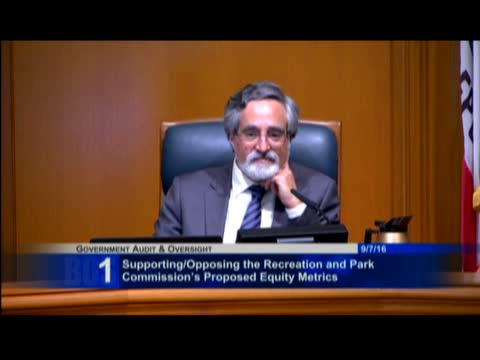
Supervisor John Avalos, who convened the special hearing, said he called the meeting because many residents felt they had "not had sufficient input" on metrics that will help the department prioritize parks, programs and investments. "I want to make sure the public can really be part of this discussion," Avalos said, asking the department to pause if more questions remain after today’s presentation.
General Manager Phil Ginsberg framed the metrics as an "iterative" lens created after Proposition B’s passage to stabilize park funding and allow longer-term planning. "Equity is a topic which exists in urban park systems," Ginsberg said, and the department views the metrics as a tool to bring "some transparency" to where services and resources are delivered.
Taylor Emerson, a department analyst, described how staff used the state CalEnviroScreen dataset to identify "equity zones" — the top 20 percent of San Francisco census tracts by a set of population and vulnerability characteristics — then mapped parks and five‑minute walking buffers to determine which park sites serve those tracts. Emerson said the department identified 81 park sites out of 220 as serving equity zones and is using multiple data sources — controller park evaluation scores, work orders, budget and program/permitt permit records — as proxies to measure access, maintenance, programming hours and investment.
Staff emphasized the metrics are preliminary and will be refined. On methodology, Emerson said the department applied a three‑year rolling average for capital investment to smooth “lumpy” funding flows and is working with SFPD to refine park‑safety indicators (Part I/Part II crimes). Ginsberg also said scholarship funding to subsidize programs rose from $80,000 to $1,300,000 annually, and that staff can report scholarship uptake by geography.
Public commenters and park advocates generally lauded the department’s work but pushed for changes. Linda Lighthizer of District 11 praised the department’s inclusion of safety metrics and urged timely repairs. Rachel Norton of the San Francisco Parks Alliance called the effort "a great start" and encouraged continued evolution and deeper public engagement.
Several commenters raised methodological concerns. A speaker identified as Tom argued the per‑capita accounting in the metrics "double‑counts" park resources for adjacent census tracts and illustrated his point with a "cookie" analogy: if multiple tracts share a park, each tract currently receives full credit, which he said inflates equity‑zone scores. He called that a "fatal flaw" that must be corrected before metrics are finalized. Staff acknowledged the critique as a useful example and said they would continue to refine the approach.
Others urged the department to distinguish program hours run by the Department from hours provided by nonprofit partners and to improve volunteer‑hour accounting, noting that some volunteer activity is informal and not recorded in department systems. Staff said they can segregate nonprofit hours in their analyses and are improving data collection (ParkStat and targeted surveys) to better capture who uses parks and for what purposes.
The presentation included examples of how the lens could change priorities: staff pointed to Alice Chalmers Park as a low‑scoring site in an equity zone that is already on a bond list for playground replacement and court resurfacings, and they listed several equity‑zone capital projects and acquisitions under way (including India Basin and Schlage Station area projects).
Procedural actions at the meeting were limited. The committee adopted a housekeeping motion to excuse Supervisor London Breed and Supervisor Norman Yee from the remainder of the meeting, and, after public testimony and discussion, agreed to "continue this item to the call of the chair" so staff can incorporate further public input and bring refinements back before final approval.
What’s next: staff said the Recreation and Park Commission will consider the metrics (staff noted a tentative Oct. 20 approval timeline at the Commission), and the department expects to refine methodology, expand outreach and produce updated metrics ahead of the next budget and capital‑planning cycle.