Get Full Government Meeting Transcripts, Videos, & Alerts Forever!
Get email alerts on the Mission Bay Transfer topic
No spam. Unsubscribe anytime.
Supervisors debate UCSF purchase of Mission Bay blocks and $7.7M NPV gap
Summary
UCSF's proposed acquisition of Mission Bay Blocks 33 and 34 would replace long‑term pilot payments with one‑time lump sums: $10.2M for affordable housing and $21.9M for infrastructure, plus CFD obligations. OCII and budget staff said the package accelerates funds for housing and infrastructure but a budget analyst and independent appraisal show a net present value gap of about $7.7M compared with the pilot. Supervisors pressed for more financial analysis, and raised transportation and transit impact concerns.
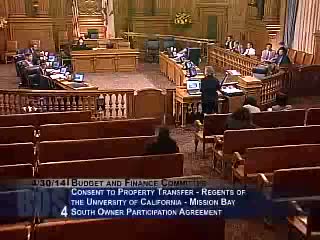
The committee considered a policy‑level resolution to consent to transfer Mission Bay Blocks 33 and 34 to the University of California (UCSF). Christine Maher (OCII) and Laurie Yamauchi (UCSF) described the proposed deal: because UC is a tax‑exempt state agency it cannot pay annual property taxes, so the parties negotiated one‑time payments and CFD obligations to replicate the financial intent of the South owner participation agreement (OPA).
Under the memorandum of understanding presented to the committee, UCSF would pay a one‑time $10.2 million affordable housing payment to the Office of Community Investment and Infrastructure (OCII) and a one‑time $21.9 million infrastructure payment to the master developer (Fossil/Forest City). UCSF would also make the special tax payments authorized under CFD #5 and CFD #6. OCII staff said these one‑time payments support accelerated affordable housing and public infrastructure construction in Mission Bay South.
Numbers and the dispute: an independent analysis (ALH Urban & Regional Economics) calculated an NPV of the tax increment the blocks would generate at about $39.8 million over 30 years, while the proposed UCSF payments have a combined NPV OCII presented as approximately $32.1 million, leaving an analyst‑identified NPV shortfall of roughly $7.7 million. OCII and the mayor’s office framed the trade‑off as one of timing and public benefit: receiving funds up front allows OCII to accelerate affordable housing and infrastructure projects that would otherwise require years of tax‑increment flow and reimbursements to developers.
Transportation and other concerns: several supervisors — most prominently Supervisors London Breed and Scott Wiener — pressed for further transportation analysis. They expressed unease that UCSF, as a state agency, would not be subject to transit impact development fees and that a condensed one‑time payment may leave the city short on resources for longer‑term transportation needs. Supervisor Breed asked for verification of OCII’s claim that UCSF’s consolidation of leased spaces will produce a $12.7M NPV of new property tax revenue to the city; supervisors asked the Department of Real Estate and other offices to confirm assumptions.
Next steps: the Budget Analyst’s office characterized approval as a policy decision for the full Board because of the identified $7.7M NPV difference. After extensive questions from supervisors and public testimony advocating both for accelerated housing and for full fiscal accounting, the committee continued the item to the call of the chair so staff can provide additional analysis and documentation requested by the board.
Representative quotes from the hearing include OCII: "We believe it is a good deal for the city" (OCII director) and the Budget Analyst: "Approval of the proposed resolution is a policy matter for the Board of Supervisors" (budget analyst).