Get Full Government Meeting Transcripts, Videos, & Alerts Forever!
Get email alerts on the Utilities Budget topic
No spam. Unsubscribe anytime.
SFPUC warns of rising capital costs; supervisors demand details on proposal to reprogram clean‑power reserves
Summary
SFPUC General Manager Harland Kelly told the Budget & Finance Committee the utility’s two‑year budget is driven by critical capital needs — including water and sewer system rebuilds and a $519M mountain tunnel project — and outlined a 4‑year rate proposal that would raise the average single‑family bill about $7–$10 per month. Discussion focused on the power enterprise’s structural shortfall and a contested mayoral proposal to reprogram Clean Power SF reserves; supervisors requested scenarios and refused to endorse reserve reprogramming without more analysis.
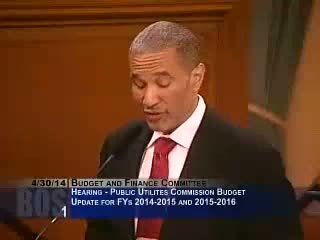
Harland Kelly, general manager of the San Francisco Public Utilities Commission, told the Board of Supervisors’ Budget & Finance Committee on April 30 that the PUC’s proposed two‑year budget is largely driven by critical capital investments and debt service for large infrastructure projects. Kelly said the water system improvement program is roughly 80 percent complete and the PUC is on pace to replace about 15 miles of water main and 15 miles of sewer pipe each year to address century‑old systems.
"The major investment is really driven by critical capital investments," Kelly said, describing a proposed commission budget increase of about $140 million tied to capital and rising electricity transmission costs. He said the commission’s rate proposal spans four years and would raise the average single‑family household bill roughly $7 to $10 per month to support 24/7 operations and the replacement program.
Why it matters: the PUC manages three enterprises (water, wastewater and power); the first two operate under rate structures designed to cover costs, while the power enterprise has historically subsidized city users and now faces structural budget pressure. That imbalance has prompted senior staff and supervisors to discuss financing options, service priorities and the distribution of costs across city government.
Power enterprise and Clean Power SF reserves: supervisors pressed Kelly on the power enterprise’s finances and on a mayoral budget proposal to reprogram some Clean Power SF (CCA) reserves. Supervisor Scott Weiner described the enterprise as close to a "fiscal cliff" and asked whether it is viable in its current form. Kelly said the enterprise remains viable if it can attract new, non‑governmental customers and secure debt financing; he said staff are exploring scenarios that would add about 100 megawatts of new load and pursue opportunities with developers and existing city land users.
Several supervisors raised strong objections when Kelly described mayoral budget language that would reallocate portions of previously reserved Clean Power SF funds to help balance the PUC budget. Supervisors who had supported the CCA signaled surprise and requested analysis and alternate scenarios before agreeing to any change. "I'm not likely to approve a budget for the Public Utilities Commission that has swiped our reserve for Clean Power SF," said Supervisor (first referenced as "Speaker 2") during the exchange, calling for the PUC to return with multiple appropriation scenarios.
Staffing, outreach and rate process: Kelly said the rate‑setting package followed an independent study required by the charter and included extensive outreach (about 100 community meetings and ~200,000 Prop 218 notices). He reported fewer than 100 formal protests had been received. The PUC also credited the Rate Fairness Board for reviewing and concurring with the staff recommendation.
Follow‑up and next steps: the committee closed public comment and continued the item to the call of the chair so PUC staff can present detailed scenarios on CCA reserve reprogramming, alternative financing choices (including debt and modest general‑fund rate adjustments), and options for expanding the power enterprise’s customer base. Supervisors asked that the PUC and mayor’s office provide more concrete scenarios that quantify the fiscal and service tradeoffs.
What the transcript shows: Kelly repeatedly emphasized capital needs (mountain tunnel rehabilitation, digesters, seawall‑related work for sewer) and framed the reserve question as a short‑notice mayoral decision. Committee members described the CCA reserve matter as a separate policy conversation that should be brought before the board with full analysis before any appropriation changes.
Next procedural step: Item 1 was continued to the call of the chair for follow‑up information and a deeper budget hearing on May 21, 2014.
Speakers quoted in this article are drawn from the committee hearing and are listed in the meeting record.