Get Full Government Meeting Transcripts, Videos, & Alerts Forever!
Get email alerts on the Awss Surplus And Resilience topic
No spam. Unsubscribe anytime.
San Francisco committee pauses planned sale of AWSS spare parts, seeks more analysis of emergency water plans
Summary
After public and firefighter objections, the Government Audit and Oversight Committee continued its review of the Auxiliary Water Supply System (AWSS) and put on hold plans to auction surplus parts, requesting a fuller pipeline and operational analysis before any sale.
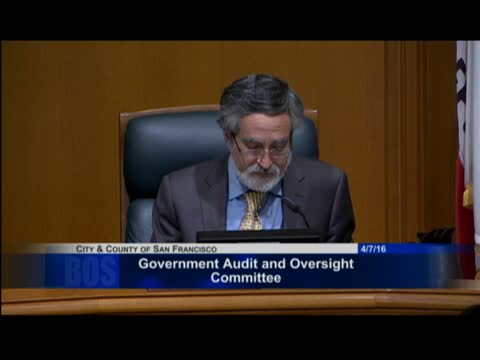
The Government Audit and Oversight Committee on April 7 continued its review of the city’s Auxiliary Water Supply System and asked the Public Utilities Commission to hold off on auctioning parts while officials complete technical assessments. Chair Aaron Peskin said the review was prompted by a March 13 newspaper report about an auction and stressed the need to reconcile what bond voters were promised with current practice.
Peskin said he wants the committee and public to understand the AWSS’s history and the disposition of parts purchased under a 1986 bond, adding that the PUC had voluntarily called off the auction after the hearing was initiated. “That sparked a curiosity on my part … about what happened with the ’86 bond money,” Peskin said, explaining the hearing’s purpose was to ask and answer those questions.
Dave Briggs, PUC local and regional water system manager, described the AWSS as a century-old, multifaceted system that now sits in a portfolio alongside cisterns and a proposed flexible-hose program. Briggs said the PUC and ratepayers have invested roughly $4.8 billion in the regional supply system, about $1 billion of which was spent inside San Francisco, and that recent bond funding provided about $150 million for AWSS-related capital and seismic work.
Briggs said PUC staff performed a conservative inventory of stored components and determined that about 30 percent of items in a city yard—mostly fittings, elbows and specialty connectors—have “no foreseeable future or purpose” under the agency’s current engineering approach. He described the economics of relocation and storage (an estimated one-time move cost of roughly $125,000 plus annual leased-space costs) and said resale value for many items would be near scrap-metal prices. “We’re not going to reap a lot of revenue from the proceeds of the sale,” Briggs said, framing surplusing as an avoided-cost decision intended to free funds for maintenance.
Fire Department leaders and retired chiefs strongly cautioned against moving quickly. Assistant Chief Ken Lombardi said the department is not abandoning the AWSS and praised recent improvements, but emphasized the difference between the gravity-fed AWSS and deployable flexible systems. “We’re not getting away from that,” Lombardi said of AWSS. He listed operational tradeoffs: AWSS can supply water immediately if undamaged, whereas a flexible-hose system requires deployment and training.
David Meyerson, the PUC project manager for AWSS earthquake-response bonds, described a planned flexible-water-supply system that would buy six hose units (each carrying 6,600 feet of 12-inch hose, roughly seven miles total) and pump units to boost pressure from selected reservoirs (Sunset, McLaren, Lake Merced). Meyerson said the hose approach is intended to address underserved neighborhoods that do not currently receive AWSS coverage.
Public commenters, retired fire officers and union representatives urged caution. Former Assistant Chief Thomas Duthier submitted a report and called the 12-inch hose substitution for AWSS expansion “an absurd scheme,” warning it is not an adequate replacement for buried pipeline expansion. Dan Casey of Local 798 said the change felt like “bait and switch” to voters who had approved bonds to expand and improve AWSS.
The committee did not approve any sale or final action at the hearing. Chair Peskin said he would continue the item to the call of the chair so staff and the PUC could produce additional technical material—particularly the pipeline-condition assessment and the hydrological planning documents—before the committee considers disposition of parts or further changes to the capital plan.
The committee also scheduled follow-up questions of PUC and Fire Department staff and said it would hold another public hearing on the topic in the coming weeks. The discussion concluded without a vote on surplusing; the PUC had already postponed the auction voluntarily after the committee initiated the hearing.