Get Full Government Meeting Transcripts, Videos, & Alerts Forever!
Get email alerts on the Mta Budget topic
No spam. Unsubscribe anytime.
SFMTA previews two-year budget and ties capital plan to November revenue measures
Summary
SFMTA Director Ed Ryskin told the Board committee the agency starts the next two-year cycle from a positive baseline but needs voter-approved revenues to close a multibillion-dollar capital gap, outlining proposals including a $500 million bond and restoring the vehicle license fee.
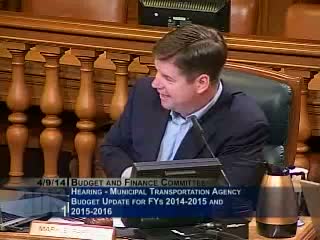
Ed Ryskin, director of transportation for the San Francisco Municipal Transportation Agency, told the Board of Supervisors Budget and Finance Committee on April 9 that the agency has a positive starting point for its next two-year operating plan but still faces large capital needs.
Ryskin said the agency’s five-year capital-improvement plan and a task force projection show roughly a $10,000,000,000 need over 15 years and that traditional funding sources cover less than half of that sum. “What the Task Force recommended to close a big chunk of the gap…is nearly $3,000,000,000 worth of new local revenue,” Ryskin said, describing proposals that include two $500,000,000 general obligation bonds, restoration of the vehicle license fee to 2 percent and an additional half-cent sales tax among options under consideration.
Ryskin outlined the near-term operating and capital figures as presented to the agency board: operating budgets of 9.47 and 9.69 (figures presented by the agency), and capital budgets of 6.23 and 7.78 for the next two fiscal years. He cautioned the committee that those figures assume passage of the first revenue measures the mayor’s task force recommended for the November ballot and noted revenues would be lower if measures are not placed on the ballot or are rejected by voters.
On risk and deliverability, Ryskin said some capital funds—especially federal grants and certain program-specific dollars—are not discretionary, and that voter-approved local revenue would be the most flexible source to accelerate projects such as fleet replacement, transit-priority work and street-surface repairs. He described several buckets of capital need—right-of-way improvements, fleet overhauls and system infrastructure including facilities, rails, elevators and stations—and said that the proposed revenue package would allow a larger, earlier investment in those areas.
Ryskin also told supervisors the agency is preparing for labor negotiations and that baseline budget assumptions incorporate currently expected terms; he said the agency will revisit proposals after negotiations and in the January 2015 fiscal-health review if revenue or labor outcomes differ from assumptions.
The committee asked for follow-up data on specific safety investments: a supervisor asked for collision and citation trends since the installation of a camera at Market and Octavia; Ryskin said the agency has the data, believes there have been no serious or fatal crashes at that intersection since the camera was installed, and offered to provide the numbers to the committee.
Procedural note: the committee continued the budget item to the call of the chair and will receive the SFMTA’s proposed budget packet as it advances through the agency board process and the Board of Supervisors’ May 1 transmittal and May 15 hearing schedule.