Get Full Government Meeting Transcripts, Videos, & Alerts Forever!
Get email alerts on the Homelessness topic
No spam. Unsubscribe anytime.
Supervisors press timeline, staffing and data as city outlines plan for a Department of Homelessness
Summary
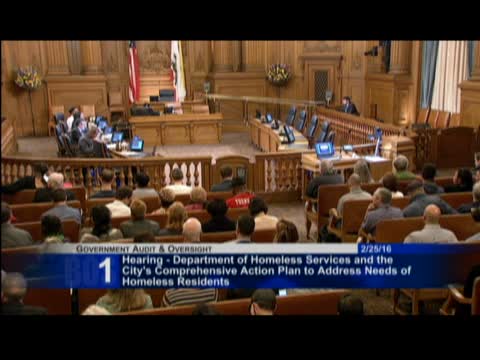
At a lengthy Feb. 25 hearing, San Francisco officials outlined goals and timelines for a proposed Department of Homelessness, reported navigation center and outreach outcomes, and faced hours of public comment demanding housing, a moratorium on sweeps, more stabilization rooms and clearer governance.
San Francisco supervisors spent the bulk of a Feb. 25 Government Audit and Oversight Committee hearing pressing city officials for details about a new Department of Homelessness proposed by the mayor’s office, while dozens of residents, service providers and advocates delivered hour‑long public comment urging immediate steps on shelter, sanitation and housing.
"There's no doubt that we need to provide the homeless population a pathway to transition into shelter and permanent housing," Supervisor Leah Cohen said as she opened the hearing. The hearing gathered presentations from the mayor's HOPE office, the Department of Public Health's Homeless Outreach Team (HOT), the Human Services Agency (HSA) and other partners to describe staffing, milestones and planned service improvements.
HOPE office director Sam Dodge described the office’s coordinating role and a numerical goal tied to the mayor’s plan: to rehouse 8,000 people in four years and reduce entries into homelessness. Dodge said HOPE is convening a San Francisco Interagency Council on Homelessness, coordinating West Coast advocacy with HUD and White House staff and calling for federal support for vouchers. "The navigation center has been a really excellent pilot," Dodge said; he reported roughly 355 people have left the streets through the navigation center pilot and said about 79% of exits were to housing or long‑term treatment.
Department of Public Health acting transitions director Kelly Hiramoto described the HOT team's structure — street outreach, medical outreach, care management and 24/7 transport — and highlighted a significant systems gap: stabilization rooms have fallen from a high of about 281 to roughly 65. "That makes it really hard to stabilize folks when you don't really have a place to hold them temporarily," Hiramoto said, linking the reduction to market dynamics and changes in hotel contracting.
HSA director Trent Rohr and homelessness program director Joyce Crum presented systemwide numbers and funding context. Crum summarized 2015 point‑in‑time data and said the HUD Continuum of Care brings roughly $30 million a year into the system; Rohr cautioned that frequently cited totals for "homelessness spending" mix shelter, housing and behavioral health allocations across departments and that not all of the commonly cited $247 million dollars are targeted at unsheltered street services.
Supervisors focused on operations and the logistics of a merger. Supervisor Jane Kim asked whether staff and program functions from DPH and HSA would transfer into the new department; city officials responded that many mainstream homeless services (shelters, outreach, rapid rehousing, drop‑ins) are intended to move to the new department, while behavioral health services will remain at DPH but closely coordinate. Dodge and others said a transfer function and reporting structure could be established within months, with administrative systems and leadership put in place by the next fiscal year, while data IT integration would likely trail that initial rollout.
Public comment filled much of the hearing. Testifiers included service providers urging a department focused exclusively on homelessness, neighborhood residents requesting stronger sanitation (daily trash pickup, needle removal and 24/7 portable toilets), advocates urging a moratorium on encampment sweeps until alternatives exist, and people with lived experience reporting barriers to accessing navigation center or shelter beds. Several speakers described being turned away from Pier 80 or the navigation center for reasons tied to quota or reservation systems, and community members pressed for immediate interim measures — porta‑potties, sharps containers and trash service — while longer‑term housing is developed.
Committee members did not adopt substantive ordinance changes at the hearing; they continued the item to the call of the chair after the presentations and extensive public testimony. Supervisors and department staff said more work is needed to finalize the governance, budget coding, data system procurement and staffing plan before the new department can be fully operational.
Key takeaways: officials outlined a concrete goal (8,000 people rehoused in four years), reported positive pilot outcomes from the navigation center, and acknowledged critical system gaps — notably the decline in stabilization rooms and the need for a unified data system. Public speakers demanded immediate moratoria on sweeps in favor of humane interim supports and called for the new department to be accountable, community‑informed and sufficiently resourced to expand exits to permanent housing.
The committee continued the matter to the call of the chair for further action.