Get Full Government Meeting Transcripts, Videos, & Alerts Forever!
Get email alerts on the Community Development topic
No spam. Unsubscribe anytime.
Top of Broadway CBD reports lower police interactions and strong non‑assessment revenue
Summary
Top of Broadway Community Benefit District told the Board of Supervisors’ Government Audit & Oversight Committee it reduced SFPD interactions by about 70% in its first two years and raised roughly 40% of its FY2014–15 budget from non‑assessment sources; OEWD recommended clearer separation of assessment and non‑assessment funds.
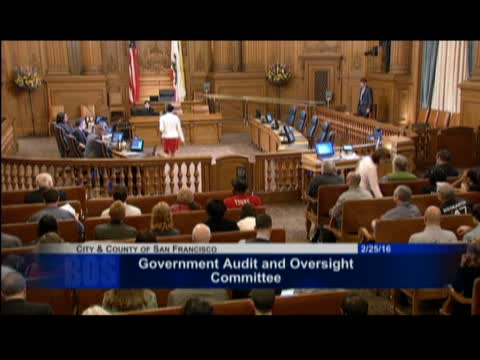
The Top of Broadway Community Benefit District reported to the Board committee on Feb. 25 that it has completed its second year of operations and delivered notable improvements in cleanliness and safety along Broadway between Osgood Place and Columbus Avenue. "We've decreased SFPD interactions by over 70% within our district," Dominic LeMondre, district manager, said during a presentation to the Government Audit and Oversight Committee.
The Office of Economic and Workforce Development (OEWD) framed the review around four benchmarks: adherence to the management‑plan budget, at least 1% of revenue from non‑assessment sources, budget‑to‑actuals within 10 percentage points, and a documented carryforward for designated projects. OEWD project manager Chris Korgas said Top of Broadway failed the first benchmark in some service categories because the district's use of non‑assessment revenue allowed it to fund services beyond the original management plan. "About 40% of the CBD's budget was from non‑assessment revenue," Korgas said, calling the district "fantastic" at raising outside funds but urging a clearer accounting method so that assessment dollars are spent in line with the management plan.
LeMondre provided operational details: the district covers 39 parcels and roughly 100–130 businesses; the operating budget for FY2014–15 was presented at about $777,000, with approximately $125,000 devoted to cleaning and safety. Services described include five‑day porter sidewalk cleaning paid at a living wage, weekly security patrols that supplement SFPD, monthly pressure washing, graffiti abatement and merchant outreach. The CBD reported 1,300 hospitality interactions, more than 2,000 merchant check‑ins, removal of more than 1,300 graffiti incidents and about 600 illegal dumping removals during the year.
LeMondre and Korgas said the board has pursued grants and donations to sustain work amid budget pressures: a $100,000 pledge from the Broadway Entertainment and Cultural Association and a $30,000 community challenge grant to install historical markers along Broadway, Columbus and Kearny. The district also has invested in marketing, banners by a local artist and increased its board to 11 members to broaden local representation.
OEWD recommended that Top of Broadway formalize an accounting approach that separates assessment dollars from non‑assessment revenues and carryforwards so that mandated assessment services remain funded according to the management plan. The committee voted to forward the CBD annual report to the full Board with a positive recommendation.
The committee did not take further administrative action on the district's management plan; OEWD said it would work with the CBD to bring categories into compliance and develop an assessment method to track funds.