Get Full Government Meeting Transcripts, Videos, & Alerts Forever!
Get email alerts on the Public Safety topic
No spam. Unsubscribe anytime.
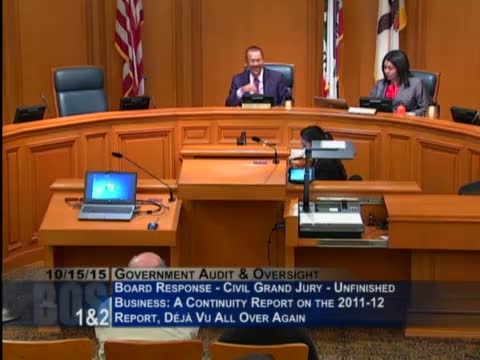
Grand Jury Warns of EMS Gaps; Fire Chief Says Recent Hires, New Ambulances and Training Plans Are Improving Response
Summary
The civil grand jury found slow ambulance response times in parts of the city and urged steps to preserve or replace the Treasure Island fire training facility. Fire Chief Joanne Hayes White described added staffing, new ambulances, improved response metrics and plans for a new EMS training facility tied to a proposed bond.
Jack Toomey, presenting for the 2014–15 civil grand jury, told the Government and Oversight Committee the jury’s investigation of the San Francisco Fire Department focused on emergency‑medical‑services response and the status of the Treasure Island training facility. Toomey said the jury found “a awful lack of strategic planning at SFFD,” pointed to slow ambulance response times in western and southern neighborhoods, reliance on some ambulances older than 10 years, and recommended returning ambulances in affected areas to static allocation.
Fire Chief Joanne Hayes White told the committee the department has taken several steps since the grand jury’s investigation. “We saw the delivery of 19 new ambulances in service. We have another 9 coming this fiscal year,” she said, and described a recent shift to a 42‑hour ambulance workweek and enhanced supervision at Station 49. Hayes White said the department has added staffing (an academy of 42 EMTs) and is coordinating closely with private ambulance partners and other city agencies to improve system performance.
On the Treasure Island training facility, Hayes White and the department argued the site provides unique live‑burn and regional training capacity that would be difficult to replicate in the city. The department envisions a new EMS facility planned as part of a 2016 health bond “to the tune of about $45,000,000,” incorporating training and replacing a temporary Station 49 facility. Bob Beck of the Treasure Island Development Authority said the adopted land‑use plan did not anticipate a permanent training facility and that continued or permanent use would require environmental review and approvals; he said nothing in the navy agreement explicitly prohibits continued operation but that further evaluation is needed.
Committee members pressed the department on response metrics and exclusive operating area (EOA) compliance. The chief said code 3 (life‑threatening) response performance has improved and the department is responding within the 10‑minute window about 87% of the time; she said market share for ambulances was about 75% (below the 80% EOA target) but improving. The department described implementing a per‑diem staffing layer to manage surge periods and noted plans to continue monitoring and to develop a comprehensive strategic plan covering hiring, apparatus replacement and facilities.
The committee voted to file item 3. Deputy City Attorney John Gibner later reported the committee met in closed session on items 4–6 and voted 2–0 to forward those settlement items to the full Board with a positive recommendation; the committee then voted not to disclose the closed‑session discussion and adjourned.