Get Full Government Meeting Transcripts, Videos, & Alerts Forever!
Get email alerts on the Technology topic
No spam. Unsubscribe anytime.
Civil Grand Jury Flags Remaining IT Gaps; City Officials Point to Recent Investments
Summary
A civil grand juror told the Government and Oversight Committee the city still underfunds critical network infrastructure and has not fully publicized results of an IT hiring pilot. Department of Technology and Human Resources officials described major IT investments and an online hiring pilot that shortened eligible-list timelines.
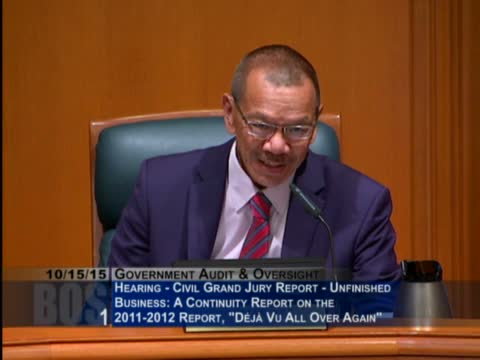
Allegra Fortunati, a 2014–15 civil grand juror, told the Government and Oversight Committee on Oct. 15 that while San Francisco has made progress since the 2011–12 IT grand jury report, “the need is for 15 to $20,000,000, much more than the 6,500,000.0 currently being invested according to the mayor.” Fortunati said the continuity review found three major outstanding concerns: underfunded network infrastructure, limited public reporting on a Department of Human Resources hiring pilot, and high vacancy rates that merit an external task force to study recruiting options.
Department of Technology Deputy Director Brian Bayless said the city has reorganized IT leadership and released a five‑year information and communications technology plan that “recommends a $150,000,000 in city general fund investments over that same time.” Bayless listed funded projects including a public‑safety radio replacement effort, a new citywide financial system, a property tax database and a citywide IT asset management rollout, and said detailed responses to the grand jury were filed with the Superior Court on Sept. 18.
Susan Guard of the Department of Human Resources described a January–July 2015 pilot that tested an on‑demand online examination for IT business analyst classifications. Guard said eight positions were announced through the pilot and six hires were made from those announcements; she added that eligible lists created from the pilot were available to other departments and that the time from job posting to an eligible list ranged between 32 and 37 days. Guard said DHR plans to present the pilot’s public report at an upcoming meeting and that the department is pursuing a broader, candidate‑focused hiring strategy.
Committee members pressed officials on full implementation costs and on whether pilot results would include price estimates for proposed recruitment measures. Chair Supervisor Norman Yee said the board disagreed with several grand jury findings in part because the Board has limited jurisdiction over hiring. Supervisors noted the Board had approved additional funding and positions but requested clearer, documented shortfalls and timelines for remaining IT projects.
The clerk read the grand jury’s ten recommendations (prioritize network infrastructure, reporting on DT reorganization, client satisfaction surveys, developing a skills inventory in eMerge PeopleSoft, DHR presentation of pilot results, monthly DHR staffing reports, launching a DT task force, interim review of task force proposals, a dedicated DT recruiter, and hiring business‑analyst talent). The committee voted to continue item 1 to the call of the chair and to forward item 2, as amended, to the full Board with a positive recommendation.
Next steps: DHR said it will share the pilot report and price tags for proposed measures when available; DT said its ICT plan and budget materials outline funded projects and that more detailed cost shortfalls would be provided where possible. The items will advance to the full Board as the committee recommended.