Get Full Government Meeting Transcripts, Videos, & Alerts Forever!
Get email alerts on the Criminal Justice Reform topic
No spam. Unsubscribe anytime.
Supervisors Hear Wide-Ranging Debate Over Jail Rebuild, Mental- health Beds and Alternatives to Incarceration
Summary
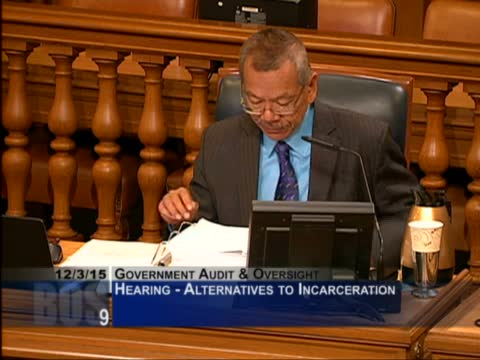
At a Dec. 3 Government and Oversight Committee hearing, prosecutors, defenders, public-health officials and city planners clashed over whether San Francisco should accept state funds to rebuild the jail or instead invest in mental-health beds, diversion programs and community treatment.
District Attorney George Gascogne told the committee the city should prioritize mental-health treatment and alternatives rather than expand jail capacity. "We do not need additional jail space," Gascogne said in his opening remarks, urging investment in mental-health beds and diversion so that people can receive treatment rather than cycling through custody.
Supervisor Kim framed the hearing as a search for alternatives to the single capital option before the Board. She said the city has "an opportunity to really reimagine the system" and asked departments to present concrete facility and program options that could reduce jail demand.
Representatives of the Public Defender's Office said attorneys already travel regularly to the San Bruno facility and urged the committee to pursue classification and programming changes that better use existing beds. The Sheriff's Department presented its pretrial-release and alternatives portfolio, including own-recognizance releases (OR), supervised pretrial release (SPRS), Court Accountable Homeless Services (CAUS), the NOVA reentry program and electronic monitoring (EM). Deputy Chief Cathy Gorwood described eligibility criteria and said denials of EM are rare and typically tied to significant public-safety concerns.
Capital Planning and Public Works described scenarios studied for replacing or reusing existing jail sites (County Jail 2 and 6). The city's analysis concluded that reopening County Jail 6 in its current dormitory configuration would carry substantial near- and long-term costs (the controller's office estimated that reopening CJ6 as proposed would amount to roughly $219 million when program, repair, staffing and transport costs are included), and that converting CJ6 to a medium-maximum cell configuration would be more expensive than building a new facility.
Controller's office staff emphasized forecast uncertainty and the range of potential bed needs (the controller's May 2015 forecast indicated between 120 and 394 beds could be required if CJ6 is not used). Capital Planning said scenarios included retrofitting CJ6 and building smaller supplemental facilities, but supervisors repeatedly pressed departments for facility proposals that house the kinds of community-based mental-health and treatment programs advocates and the DA described.
Department of Public Health detailed existing alternatives and new initiatives: the sobering center and the Community Justice Center, behavioral-health and veterans courts, a proposed psychiatric-respite site at San Francisco General (a 47-bed voluntary facility), and the ABLE (Assistance Before Law Enforcement) pilot for lower-level drug and mental-health calls. Joe Robinson (DPH) told the committee many individuals improve with in-custody treatment but stressed that housing and community-based care are needed to sustain gains after release.
Public speakers, including community groups and advocacy organizations, urged the Board to pursue the Memphis- and Miami-style mental-health diversion models cited by the DA and asked for clear data showing how many people could be diverted with expanded programming and eligibility. Several speakers said the presentations lacked the concrete analyses and program-level capacity numbers the Board requested six months earlier.
Outcome: The committee did not vote on the jail-rebuild proposal. Members voted to continue the item to the call of the chair so departments can provide additional analysis and alternatives.