Get Full Government Meeting Transcripts, Videos, & Alerts Forever!
Get email alerts on the Assessor Backlog topic
No spam. Unsubscribe anytime.
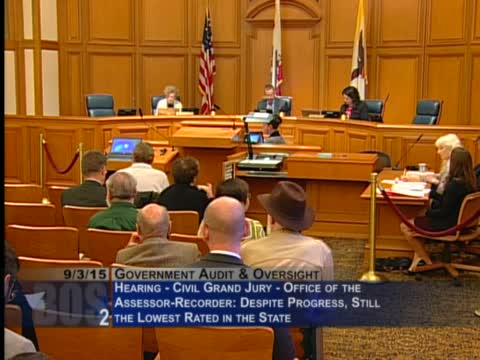
Civil grand jury warns of assessor backlog; committee accepts most findings with caveats
Summary
The committee reviewed a civil grand jury continuity report faulting the Office of the Assessor‑Recorder (OAR) for backlog and low assessment ratio; OAR and jurors differed on causes and timelines. The committee agreed with several findings but added caveats on funding and staffing.
Committee members heard a continuity report from the 2014–15 Civil Grand Jury that found the Office of the Assessor‑Recorder (OAR) remains the lowest‑rated county office in the state on the Board of Equalization assessment ratio and continues to carry a backlog of parcels needing reassessment. Janice Petty, foreperson of the 2014–15 Civil Grand Jury, and Allegra Fortunati, principal writer, urged clearer annual reporting, a forward‑looking staffing analysis and a long‑term plan to eliminate the backlog.
Fortunati told the committee the jury found San Francisco’s assessment ratio at 97.59 and that the backlog contributed to delayed tax revenues in earlier surveys. She recommended that OAR produce a staffing analysis that projects staffing needs under different market scenarios and suggested the county apply SCAP grant funds and local match to reduce backlog.
Edward McCaffrey, speaking for the Assessor‑Recorder, acknowledged progress and thanked the Board for recent budget support. He said the OAR received a State‑County Assessors Partnership grant and described the office’s FY2015–16 general fund budget of $22 million for staffing and technology. On the ability to clear the backlog by fiscal year 2016–17, McCaffrey said that timeline was "unrealistic" without continued funding, operational efficiencies and favorable market conditions.
Committee members generally "partially agreed" with the grand jury’s findings: they accepted that SCAP funding and recent budget actions help but noted that the one‑time grant is limited in time and unlikely by itself to eliminate the backlog. The committee asked the assessor’s office to provide a more complete staffing analysis and adopted amended responses and a committee report to forward to the full Board.