Get Full Government Meeting Transcripts, Videos, & Alerts Forever!
Get email alerts on the Reentry Pod Contract topic
No spam. Unsubscribe anytime.
Committee advances sheriff's three‑year contract with CDCR for 56‑bed reentry pod, with reporting and approval conditions
Summary
The committee advanced a resolution authorizing the Sheriff's Department to contract with the California Department of Corrections and Rehabilitation to establish a secure reentry pod for up to 56 inmates under AB109 realignment. Budget analysts recommended, and the committee adopted, amendments requiring Board approval of any future contracts that increase transferred inmates or length of stay and annual reporting on average daily population.
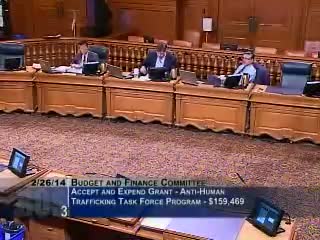
The Budget & Finance Committee on Feb. 26 voted to advance an amended resolution authorizing the Sheriff's Department to enter into a three‑year contract with the California Department of Corrections and Rehabilitation (CDCR) to operate a secure reentry pod under AB109 realignment.
Sheriff McCormick described the program as a county‑level pilot to receive up to 56 state inmates into a reentry pod that the Sheriff and adult probation would jointly manage. The sheriff said the approach aims to reduce recidivism by providing continuous programming — cognitive behavioral therapy, restorative justice, parenting classes and substance‑abuse treatment — during custody and continuing under probation supervision upon release.
Chief Still (adult probation) said the department's calibrated estimate for average daily population is 24 inmates rather than the full 56, and that state reimbursements under the contract are structured for up to 56 inmates and not to exceed roughly $4.2 million over three years. Budget analyst Mr. Rose reported that based on an average daily population of 24 the state's total expected reimbursements would be about $2 million over three years, and estimated incremental city costs would be offset by the state's reimbursement. Mr. Rose recommended amending the resolution to require the Sheriff's Department to return to the Board for approval of any future contract expanding the number of transferred inmates or the length of stay, and to require annual reporting to the Board and the Capital Planning Committee on average daily population.
Supervisors expressed a desire to reconcile differing figures and vet the numbers; sheriff and probation officials said they were willing to proceed under the 60‑day/56‑bed approach and return to the Board if state policy expands transfers to up to 365 days. The committee adopted the analyst's recommended amendments and moved the amended resolution forward without objection. The committee also requested the department provide any amended resolution paperwork to the clerk by the stated deadline.