Get Full Government Meeting Transcripts, Videos, & Alerts Forever!
Get email alerts on the Language Access topic
No spam. Unsubscribe anytime.
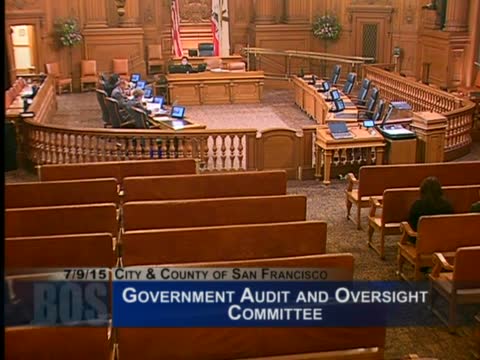
Committee approves amendment to language-access pilot, refers ordinance to full board
Summary
The Government and Oversight Committee advanced a pilot ordinance to provide interpretation services in Spanish, Tagalog and Chinese at Board of Supervisors meetings beginning Sept. 2015, removing a requirement to translate the full agenda because of logistical concerns; the measure was referred to the full board as a committee report.
Supervisor Yee introduced an ordinance to create a pilot program that would make language assistance available at Board of Supervisors meetings, saying the city currently struggles to provide on-demand interpreters and that the pilot would offer Spanish, Tagalog and Chinese beginning in September 2015.
"This legislation will create a pilot project to offer language assistance in Spanish, Tagalog, and Chinese at all board of supervisors meetings starting in September, 2015," Supervisor Yee said, noting the pilot would run through July 2016 and that her office worked with the Office of Civic Engagement and Immigrant Affairs (OCEIA).
Adrienne Pahn, Executive Director of the Office of Civic Engagement and Immigrant Affairs, told the committee that San Francisco has a strong language-access law and that outreach data show substantial multilingual needs: "more than one in three San Franciscans is an immigrant" and the Bay Area records more than 100 languages, with Cantonese, Mandarin and Spanish among the top languages for limited-English-proficient residents.
OCEIA staff described the unit's work and limits: staff perform both interpretation (spoken) and translation (written), provide community outreach grants (about $400,000 annually) and manage the city's telephonic-interpretation contract with LanguageLine Solutions. Presenters emphasized that translation projects can require dozens of staff hours and that last-minute agenda translations pose logistical challenges.
Deputy City Attorney John Givner told the committee the ordinance as drafted required translation of the full board agenda and the "legislation introduced" document but not the substantive text of legislation. He said translating the agenda on the Board's current production schedule would be difficult and advised removing that requirement as an amendment.
After public testimony was called and none was offered, Supervisor Christensen moved to remove the agenda-translation requirement. The amendment was adopted "with no objection," and the committee then referred the ordinance to the full Board as a committee report for consideration at the upcoming meeting.
The committee asked OCEIA and the Clerk's Office to work together to develop efficient protocols and targeted public-noticing so translated information gives community members enough detail to participate.
Next steps: the amended ordinance will appear on the Board of Supervisors agenda for full consideration; the committee directed staff to finalize language on what parts of notices will be translated to balance accessibility with logistical constraints.