Get Full Government Meeting Transcripts, Videos, & Alerts Forever!
Get email alerts on the Drug Stewardship topic
No spam. Unsubscribe anytime.
Committee advances ordinance to require drug makers fund city take‑back program
Summary
The Government and Oversight Committee voted to send to the full Board a proposed ordinance that would require manufacturers selling drugs in San Francisco to finance and operate stewardship plans for safe collection and disposal of unwanted medicines, citing pilot results that collected roughly 23.5 tons of drugs.
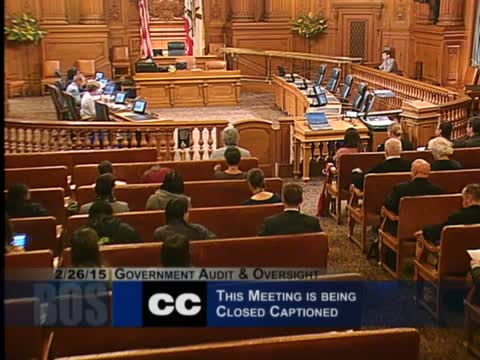
San Francisco — The Government and Oversight Committee voted Feb. 26 to forward to the full Board of Supervisors an ordinance that would require drug manufacturers who sell products in San Francisco to fund and operate approved stewardship programs for the collection and safe disposal of unwanted medicines.
Sponsor President Breed said the proposal responds to both public‑safety and environmental concerns, pointing to a city pilot that collected about 23.5 tons (approximately 47,000 pounds) of pharmaceuticals and to poison‑control and overdose statistics that she said show a need for accessible disposal options. “This legislation will require drug manufacturers with city oversight to fund and operate full collection programs,” Breed said in her opening remarks.
The ordinance would require producers to submit stewardship plans — singly, in multi‑party coalitions or via third‑party product stewardship organizations — that meet standards set in the city code. Department of the Environment staff said plans would be reviewed on four‑year cycles and that producers must provide sufficient convenience for residents, with a minimum goal of five drop‑off sites in each supervisorial district (a citywide minimum of 55 sites) and required participation by the city’s two city‑run pharmacies.
Department director Debbie Raphael framed the measure under Chapter 1 of San Francisco’s Environment Code, invoking the precautionary principle and arguing the city has evidence of harm and cost‑effective remedies. “With the level of science we understand now, even tiny levels of these chemicals can and do have impacts on the ecosystem,” Raphael said.
Guillermo Rodriguez of the Department of the Environment walked supervisors through implementation milestones the ordinance sets: wholesalers must notify the department within two months of the effective date who is selling covered drugs into San Francisco; producers must acknowledge coverage within six months; producers must invite pharmacies and law enforcement to participate within nine months; stewardship plans would be submitted within 12 months and reviewed by the department within three months. Staff estimated the city could have a program operating roughly 18 months after the ordinance’s effective date.
The department said the pilot — which included 12 independent pharmacies, one community center and all 10 police stations — demonstrated the approach is workable but not yet sustainable. Raphael said initial private seed funding (including contributions from pharmaceutical companies and Genentech) covered about 40 percent of pilot costs and that an ongoing funding mechanism is needed. She estimated annual program costs in the range of $400,000 to $500,000 for San Francisco’s program design and oversight.
Public health testimony supported the ordinance. Dr. Judith Martin of the Department of Public Health said take‑back programs dovetail with efforts to reduce opioid harm and cited local figures on prescription‑poisoning deaths and thousands of poison‑control calls. “Take back programs fit and dovetail into this effort,” Martin said.
Environmental and nonprofit speakers — Save the Bay, Sierra Club and the California Product Stewardship Council among them — emphasized monitoring showing pharmaceuticals in Bay wildlife and urged the city to act. Workers‑safety testimony came from Recology and a permitted medical‑waste hauler, both of which said reducing medicines in regular trash lowers worker exposure.
Industry representatives urged changes. Richard Engelhart of BayBio said much pharmaceutical pollution enters waterways through human excretion and questioned how much water‑quality benefit take‑back programs alone would deliver; he also urged stronger retailer participation and criticized the ordinance’s prohibition on consumer fees as a potential barrier to signaling long‑term disposal options. The Chamber of Commerce asked the committee to consider making the ordinance effective only after federal courts resolve a separate Alameda County case; supervisors declined that delay and instead adopted a clerical amendment addressing definitions.
The committee adopted two clerical amendments — clarifying the definition of producer/manufacturer and that wholesalers who are not manufacturers are exempt — and then voted, by voice and without recorded roll call, to send the ordinance as amended to the full Board with a positive recommendation.
If approved by the full Board and the mayor, the ordinance would charge manufacturers with producing stewardship plans, providing required reporting (annual producer reports, department biannual reports), carrying out education and language‑access outreach, and meeting minimum convenience metrics. The measure includes civil penalties (staff noted up to $1,000 per day per violation in the draft) and the department would have rulemaking and enforcement authority.
Next steps: the ordinance will be scheduled for consideration by the full Board of Supervisors; the committee action does not itself adopt the regulation. The committee also approved two unrelated annual report resolutions during the same meeting.