Get Full Government Meeting Transcripts, Videos, & Alerts Forever!
Get email alerts on the Lgbt Long Term Care topic
No spam. Unsubscribe anytime.
Supervisors hear first‑in‑nation ordinance to protect LGBT residents in long‑term care facilities
Summary
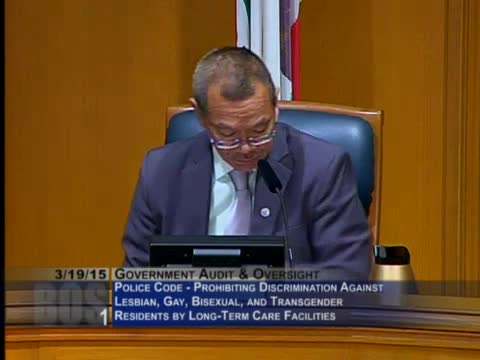
The Government Audit and Oversight Committee reviewed an ordinance sponsored by Supervisor Scott Wiener that would amend the San Francisco Police Code to create a bill of rights protecting LGBT residents and patients in long‑term care facilities, adding facility‑specific rules, training requirements, and a private right of action; the committee voted to forward the measure to the full Board with a positive recommendation.
Supervisor Scott Wiener on Thursday asked the Board committee to forward an ordinance amending the San Francisco Police Code to prohibit discrimination against residents or patients in long‑term care facilities on the basis of sexual orientation, gender identity, gender expression or HIV status.
Wiener, the measure's sponsor, told the Government Audit and Oversight Committee the ordinance would create an explicit "bill of rights" for LGBT seniors in nursing homes, assisted‑living and other congregate care settings and cited the LGBT Aging Task Force report (March 2014), which estimated about 25,000 older adults in San Francisco identify as LGBT. He said the ordinance spells out specific facility duties — such as designating an LGBT liaison who must undergo periodic training, respecting residents' preferred names and pronouns, allowing restroom access consistent with gender identity, prohibiting involuntary room reassignment based on complaints about a resident's orientation or identity, and ensuring access to culturally competent medical care.
The nut graf: supporters told the committee the change is intended to clarify and operationalize state nondiscrimination protections within the unique context of long‑term care, where residents depend on staff for daily needs and may lack usual privacy and family‑based support. Daniel Redmond, a member of the LGBT Aging Task Force and an attorney who helped draft the ordinance, described surveys showing high levels of fear among LGBT seniors about being open in care settings and cited instances documented by advocacy groups where partners were separated or transgender residents were denied appropriate care.
Speakers from the National Center for Lesbian Rights, the San Francisco Human Rights Commission, Open House, the ACLU of Northern California and the Transgender Law Center testified in support and urged the supervisors to adopt the clarified rules and training requirements. Melaine Ahern of the Human Rights Commission noted complaint statistics to the Commission and flagged a potential technical issue: Article 33's one‑year statute of limitations could conflict with Article 38's two‑year limit for claims involving HIV status; the committee asked staff to provide more detail by email.
Committee action and next steps: after public comment, the committee adopted a motion to forward the ordinance to the full Board with a positive recommendation. There was no recorded roll‑call vote in committee; the motion was announced as passing without objection. If the full Board approves the ordinance, it would direct the Human Rights Commission to publish guidance for facility compliance and would create a private right of action for residents who cannot resolve disputes through mediation.
The measure also contemplates outreach and training: Wiener said the City intends to work with provider associations (California Association of Health Facilities, California Assisted Living Association), the Human Rights Commission and local advocates to distribute guidance; however, committee members asked for more detail on outreach plans and implementation timelines.
The committee forwarded the ordinance to the full Board, where it will receive further committee reports and potential amendments before a final vote.