Get Full Government Meeting Transcripts, Videos, & Alerts Forever!
Get email alerts on the Prop 47 Hearing topic
No spam. Unsubscribe anytime.
Supervisors, prosecutors and public defenders outline limited local effects but large administrative work from Prop 47
Summary
City officials told the Government Audit and Oversight Committee that Proposition 47's immediate impact in San Francisco has been modest but has created substantial administrative work to review and, where appropriate, resentenced hundreds of cases; officials urged clear plans to direct savings to treatment and reentry supports.
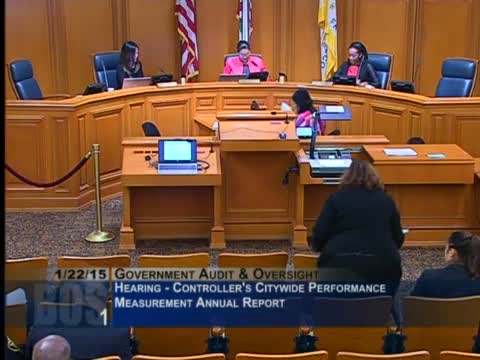
Supervisor Malia Cohen convened a multi-agency hearing to assess local effects of Proposition 47 after it passed statewide last November. "Prop 47 was passed last November by the voters," Cohen told the Government Audit and Oversight Committee, framing the session around questions of resentencing, operational change and how any savings should be reinvested locally.
A District Attorney's Office representative said the office identified roughly 900 potentially eligible county cases and has been reviewing files with other agencies. "We have approximately 900 cases that are potentially eligible," the DA's representative said, adding that about 300 are drug cases and about 600 fall into other categories. He said 375 cases previously charged as felonies had already been reduced to misdemeanors and four San Francisco residents in state prison were eligible for resentencing and released.
SFPD Commander Robert Moser described operational changes for patrol officers: "Officers are required to issue a citation and release suspects at the scene" for many offenses reclassified to misdemeanors, with limited exceptions for booking. He warned the shift could change reporting and arrest patterns and noted early local data (82 Prop 47 cases in November 2014, 76 in December 2014) showing a rising share eligible for citation release.
Adult Probation Deputy Chief Marty Krzet said the department reviewed 888 active probation cases and found 650 ineligible under the statute; it recommended reduction and termination of probation in 103 cases and reduction while retaining misdemeanor supervision in 135 others. "Allowing a client to continue to receive these services while on misdemeanor probation may be the best use of our resources over the long run for public safety," Krzet said.
The public defender's office described a broad intake and outreach effort, reporting walk-in clinics and thousands of past files to screen: an initial Superior Court query identified about 6,900 potential cases in its records for review. The office and the DA said they were streamlining many petitions by stipulation to reduce court hearings.
Officials repeatedly highlighted unresolved policy questions. The police and DA raised concerns about whether DNA profiles taken during felony arrests would be removed from state databases after resentencing and said that issue might require state legislative fixes. SFPD also noted that drug court participation may decline when cases are misdemeanors, which could reduce a previously strong incentive to enter treatment.
Members of the public and community advocates urged that any savings be directed to neighborhood-based reentry and substance-abuse programs, particularly in District 10. Paul Anderson of the mayor's office said the city budget office is preparing department-specific analyses of cost implications and that further hearings are likely.
Chair London Breed and Supervisor Cohen said the hearing made clear a need for more structured coordination. Cohen moved to continue the item to the call of the chair so departments could produce more detailed timelines and budget estimates; the motion passed without objection. The Mayor's office and department heads were asked to return with more specific cost and implementation plans.
Next steps: departments will continue their case reviews, the mayor's budget office is compiling departmental impacts, and the committee left the Prop 47 item continued to the call of the chair for follow-up reporting.