Get Full Government Meeting Transcripts, Videos, & Alerts Forever!
Get email alerts on the Homelessness topic
No spam. Unsubscribe anytime.
Committee approves recommendation to accept $978,000 forgivable loan to create 100-bed Bayview shelter after extended debate
Summary
After hours of testimony and sharp debate over outreach, zoning and safety, the Budget & Finance Committee voted to forward a resolution authorizing the Human Services Agency to accept a $978,000 forgivable loan to convert 2115 Jennings Street into a 100-bed, 24/7 shelter adjacent to Mother Brown's resource center; opponents raised process and CEQA concerns.
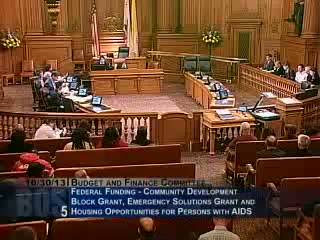
The committee spent the majority of its meeting on Item 3: a resolution authorizing the Human Services Agency (HSA) to accept a $978,000 forgivable loan from the California Department of Housing and Community Development to renovate 2115 Jennings Street into a 100-bed homeless shelter adjacent to Mother Brown's drop-in resource center in the Bayview.
District 10 Supervisor (Supervisor Cohen) opened public remarks on the item, saying she had conducted community meetings after neighbors raised concerns and that the neighborhood had not been adequately consulted before the city applied for the state funds. "This issue has split the community," Cohen said, citing a lack of prior outreach, the PDR zoning classification at the site, and unanswered questions about impacts and mitigation.
Trent Rohrer, Director of the Human Services Agency, described the sequence that led to the application: HSA staff observed people sleeping in chairs in a neighboring resource center and identified a vacant industrial building next door; given a statutorily constrained grant deadline, HSA applied for the forgivable loan and later began community discussions. Rohrer said the grant of $978,000 was to pay for the basic build-out and that operational funding (about $500,000 a year) is included in the 2013-14 budget and would need to be addressed in future budgets. He told the committee the agency planned a competitive procurement to select a shelter operator and expected subsequent land-use and lease approval steps, including a special-use-district (SUD) planning process and additional Board votes.
Opponents and neighborhood speakers raised multiple objections: that the Bayview did not need more beds, that the unsheltered count used to justify the grant contained duplicates, that the location is zoned industrial (PDR) and not appropriate for residential use, and that accepting state funds before CEQA and rezoning could be legally premature. David Eisenberg, speaking for nearby businesses, cited Tara v. City of West Hollywood in arguing city acceptance of a grant prior to environmental review may be improper and estimated costs well above the grant amount.
Supporters, including volunteers and leaders from Mother Brown's, United Council/Hope House, veterans'serving organizations and other Bayview residents, urged the committee to accept the loan so the city could provide beds and services to people who were already sleeping in chairs or on the street. Multiple speakers gave personal testimony about people they had seen sleeping in chairs and about the role of Mother Brown's in connecting people to services.
Supervisors from across the dais recognized the process concerns raised by the district supervisor but also stressed the urgent need for additional beds in the Bayview. After further discussion and acknowledgement of the need for continued community engagement, the committee moved to forward the resolution with a positive recommendation to the full Board.
What's next: The resolution forwarded by the committee authorizes acceptance of the grant; subsequent steps mentioned by HSA include lease approval, SUD planning review, CEQA compliance and a competitive procurement to select the shelter operator. The Board of Supervisors will consider the resolution and any land-use and budget steps that follow.