Get Full Government Meeting Transcripts, Videos, & Alerts Forever!
Get email alerts on the Citycollege topic
No spam. Unsubscribe anytime.
Board committee hears economic-impact study and broad public testimony urging action to save City College
Summary
A committee hearing on a Budget & Legislative Analyst study found San Francisco City College generates at least $311 million in annual economic activity and that closure or accreditation loss would jeopardize federal/state grants and workforce programs; the hearing drew extensive public testimony from faculty, students, trustees and community leaders calling for action and alleging bias by the accrediting commission.
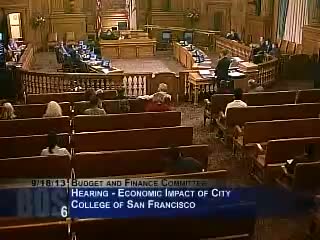
The Budget & Finance Committee convened a hearing on a Budget & Legislative Analyst study that estimated the economic impact of a potential closure of San Francisco City College (CCSF). Supervisor Eric Marr (head sponsor) introduced the study and emphasized its focus on quantifying benefits for students, workforce programs and vulnerable populations.
Severn/Severin Campbell, the report's primary author from the Budget and Legislative Analyst Office, summarized the study's scope and key findings. Using enrollment and financial data from 2010–13, Chancellor's Office data, federal labor statistics and limited surveys, the analyst said CCSF served nearly 80,000 students in 2012–13, with about 41% in noncredit courses; roughly 16,000 students were English learners and about 5,000 students lacked a high-school diploma. The report estimated CCSF generated "over $311,000,000 per year in economic activity" for the city and county, and noted the college received about $188,000,000 in federal and state grants in 2010–11 that could be at risk if the institution closed or lost accreditation. The analyst cautioned the study did not evaluate alternatives (such as mergers or program reductions) and that data were limited in places; Campbell said further, more granular analysis could explore industry-specific workforce impacts.
The hearing drew substantial public comment. Alisa Messer, president of AFT 2121 and an English instructor at CCSF, said the report was valuable but did not fully capture recent changes since accreditation problems surfaced, including staffing reductions. Faculty and staff speakers recounted City College's role as a safety net and pathway to jobs, cited programs (ESL, GED, EOPS, CityBuild, workforce academies), and described the potential wage impacts for populations who could lose access to courses. Several public speakers, including trustee and student leaders, accused the Accrediting Commission for Community and Junior Colleges (ACCJC) of political bias or conflict of interest; multiple speakers referenced the city attorney's litigation challenging the commission.
Supervisors praised the study and testimony and asked the Budget & Legislative Analyst Office for follow-up analysis in specific areas (industry breakdowns, public‑health impacts and program‑level effects). Supervisor Marr moved to continue the item to the call of the chair for additional follow-up; the committee approved that request and adjourned. No formal committee vote on a policy action was recorded at the hearing.