Get Full Government Meeting Transcripts, Videos, & Alerts Forever!
Get email alerts on the Criminal Justice topic
No spam. Unsubscribe anytime.
Committee authorizes application for state grant to replace aging Hall of Justice jails amid debate
Summary
The Budget & Finance Committee authorized applying for up to $80 million in state SB 1022 financing to replace County Jails 3 and 4, proposing a modern 640‑bed direct-supervision facility. Supporters cited safety, seismic risks and program space; opponents and many public commenters urged alternatives to incarceration and warned of a "build it and they will fill it" effect.
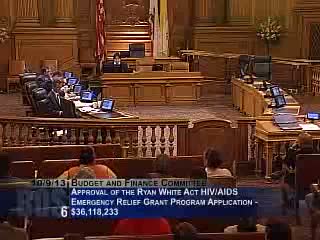
The committee voted on Oct. 9 to authorize the city to apply for up to $80 million in competitive state financing (SB 1022) to replace the top two floors of the Hall of Justice—County Jails 3 and 4—after a lengthy presentation and public comment session.
Brian Strong, project lead, and staff described repeated structural assessments that conclude the Hall of Justice’s upper floors pose life-safety risks in a major seismic event and chronic operational deficiencies (cramped cells, limited programming space and outdated linear design). They said a replacement project is in the capital plan and estimated the current project cost at roughly $290 million, with construction planning to begin in 2017 and substantial completion in 2019 if financed.
Staff and the controller’s office presented a revised population forecast reflecting state realignment and declining jail populations; those studies supported a replacement facility sized to 640 beds (about 30% smaller than the historical 905-bed figure). The presentation stressed that applying for the state grant does not commit the city to immediate purchase or construction, but that SB 1022 rules could require site acquisition within 90 days of award if funds are accepted.
Supporters, including the Sheriff’s Department, framed the replacement as a public-safety and humane-practices upgrade: a modern, podular direct-supervision design would allow real-time observation, safe housing and on-site rehabilitative programming to reduce recidivism. "We need capacity and program space to do rehabilitation and family reunification work," an undersheriff said.
Opponents—many members of the public and several supervisors—urged alternatives: reinvesting in housing, mental-health and community programs; expanding diversion and reentry services; and avoiding a "field of dreams" outcome where new cells encourage incarceration. Public commenters said building new jail capacity risks increasing incarceration of poor people and people of color and urged that state funds instead support community-based solutions.
The Budget and Legislative Analyst noted the grant application does not meet all RFP preferences (the RFP asks that a project be ready to proceed in its entirety), and that if awarded, acceptance would still require Board approvals including CEQA and funding authorizations before construction. After debate, the committee adopted technical amendments and voted to authorize filing the application; the roll call recorded Avalos "aye," Marr "no," Farrell "aye."
What happens next: The application is due Oct. 24. Receipt of an award would trigger further Board-level approvals (accept-and-spend, CEQA, property acquisition and financing) before any ground-breaking. The Board or public could still reject accepting state funds if other conditions are not met.