Get Full Government Meeting Transcripts, Videos, & Alerts Forever!
Get email alerts on the Language Access topic
No spam. Unsubscribe anytime.
Committee hears wide-ranging Language Access Ordinance update; votes to table further action
Summary
Supervisor David Chu convened an annual Language Access Ordinance update; OSEA certified Tagalog as a threshold language, departments reported progress and gaps (SFPD, OEWD, DPH, Real Estate, Rec & Park), community speakers urged better outreach and translated notices; the committee tabled further action to refine recommendations.
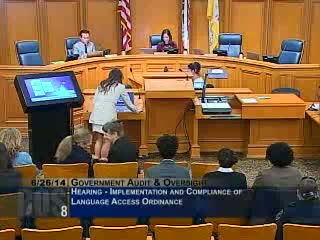
The committee held a full hearing on the Language Access Ordinance (LAO) annual compliance report and received presentations from the Office of Civic Engagement and Immigrant Affairs (OSEA), multiple Tier‑1 departments and community advocates.
Sponsor Supervisor David Chu opened the hearing, noting the city's diversity and the need to ensure "equal and full access to services and timely information regardless of whether or not English is one's first language." Adrienne Pahn and Isis Fernandez Sykes of OSEA presented the OSEA annual report, describing citywide compliance metrics, demographic data and a baseline study used to certify Filipino/Tagalog as the city’s third required language under the ordinance.
Pahn and Fernandez Sykes highlighted persistent gaps: inconsistent data collection across departments, variability in translation and interpretation quality, and resource constraints. Their recommendations included eliminating the tiered compliance structure so all departments comply, moving from annual to biennial reporting to reduce burden, centralizing document translation contracts and funding a citywide language‑services unit. They also proposed a single threshold (10,000 LEP speakers) for certification.
Departmental witnesses described operational practices and constraints. SFPD officials said a Department General Order requires officers to provide free language assistance to LEP individuals and highlighted tools including station language cards, a staffing database and department‑issued smartphones with translation capability; the chief noted a small number of sustained complaints in 2012–13 that resulted in retraining. OEWD described bilingual business and workforce outreach and proposed continuing both in‑house capacity and OSEA collaboration. Real Estate staff demonstrated a prototype multilingual kiosk and wayfinding system for City Hall (budgeted ~ $150,000) with an English rollout followed by phased language additions (proposed order: Chinese, Spanish, Filipino, Russian); they signaled ADA and procurement steps are pending. DPH detailed significant language capacity — roughly $5.6M spent on language assets and about 1,000 bilingual staff — expansion of video medical interpretation and quality‑control training; Rec & Park reported increased translation spending and scholarship‑application translations into multiple languages.
Community speakers and language‑access advocates emphasized gaps between policy and practice. Translators, neighborhood advocates and nonprofit service providers described notices and meeting materials issued only in English, barriers for older and linguistically isolated residents, long wait times for interpretation in some contexts, and the importance of high‑quality human interpretation over machine translation for sensitive encounters.
After presentations and extended public comment, Supervisor Chu moved to table the item to allow staff and the board to refine recommendations and follow up on resource and reporting proposals; the motion carried "without objection." The chair said the Board would schedule further hearings to work on enforcement, reporting clarity and resource allocation.
OSEA and departments committed to additional reporting and to work with community partners to implement improved outreach, centralized translation contracting, and training recommendations.