Get Full Government Meeting Transcripts, Videos, & Alerts Forever!
Get email alerts on the Community Choice Aggregation topic
No spam. Unsubscribe anytime.
Committee moves forward study of joining Marin Clean Energy for a Community Choice program
Summary
The committee agreed to move out for further study an ordinance to study San Francisco’s feasibility of joining Marin Clean Energy’s Community Choice Aggregation program after an MCE presentation and multiple public comments urging a focus on local renewables and jobs.
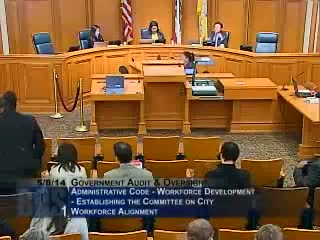
SAN FRANCISCO — The Government Audit and Oversight Committee voted to move forward on a feasibility study to explore whether San Francisco should pursue a Community Choice Aggregation (CCA) arrangement with Marin Clean Energy (MCE).
An MCE representative described the agency’s program, which has operated since 2010 and serves about 75 percent of customers in Marin and parts of Richmond. The speaker outlined three product tiers — a 50 percent renewable “Light Green” option, a 100 percent renewable “Deep Green” option, and SoulShares, a 100 percent local product tied to a specific local installation — and highlighted MCE’s local procurement and energy-efficiency work. The representative said MCE’s portfolio has an emissions rate they estimate is roughly 19 percent lower than the incumbent utility.
Jason Fried, LAFCO staff, explained joining an existing JPA such as MCE is one option and noted LAFCO has examined different models and funding approaches. Fried said LAFCO has a special fund for CCA activities that might be used to pay for feasibility work; MCE said an independent quantitative analysis is typical and that Richmond’s analysis cost about $40,000, while a study for a jurisdiction the size of San Francisco would likely cost substantially more.
Public commenters and local advocates urged strong local-installation and job requirements. Jed Holtzman of 350 San Francisco and San Francisco Clean Energy Advocates said joining MCE could help deliver cleaner power at competitive rates while enabling a local renewables build-out. Haley Pedersen of the Sierra Club said the Sierra Club supports Clean Power SF and that a study of Marin Clean Energy could provide useful information. Eric Brooks of the San Francisco Green Party and Clean Energy Advocates emphasized the need to secure local jobs and local generation from any CCA arrangement. Sheriff Ross Mercurini recounted the city’s CCA history and pointed to past political opposition to municipal programs, noting the experience of other Bay Area CCAs.
Supervisor John Avalos, the item sponsor, said the ordinance requests a study and does not authorize joining a JPA; he said LAFCO funds could cover study costs. Committee members agreed to move the item out as a committee report for further study and review.
The committee did not record a roll-call vote; the item moved forward 'without objection.' The feasibility study will return to the Board process if pursued further.