Get Full Government Meeting Transcripts, Videos, & Alerts Forever!
Get email alerts on the Bmr Vacancies topic
No spam. Unsubscribe anytime.
Budget analyst finds 305 vacant below‑market‑rate units; MOHCD outlines lease-up steps and support, committee asks for annual reporting
Summary
A BLA report found 305 vacant Below‑Market‑Rate rental units (1,961-unit inventory); MOHCD described DAHLIA operations, reasons for delays and enforcement steps; the committee continued the hearing and requested follow-up reporting and coordination to speed lease-ups.
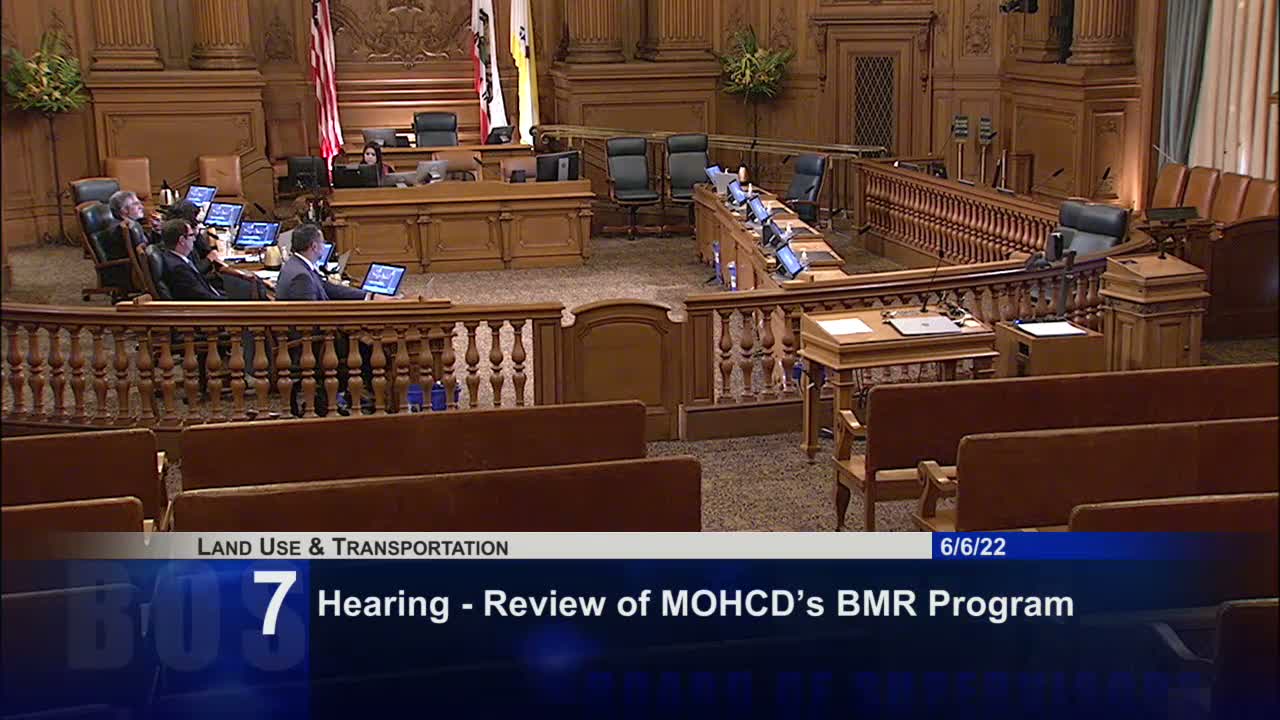
The Land Use & Transportation Committee held an extended hearing June 6 on the Mayor’s Office of Housing & Community Development’s (MOHCD) Below Market Rate (BMR) program after a Budget & Legislative Analyst (BLA) report found 305 vacant BMR rental units citywide out of 1,961 units in 101 buildings (a 15.6% vacancy rate as of the BLA snapshot).
Dan Goncher of the BLA presented the audit: 305 vacancies (69% targeted to households at ≤55% AMI; 30% targeted at 55–100% AMI), with 53% of vacant units being SROs/studios/one-bedrooms; 80% of the vacancies began in 2021–2022. BLA described the enforcement timeline (notice of complaint, notice of enforcement, planning referral, notice of violation and $250/day administrative penalties assessed by Planning if unresolved) and suggested policy options: quarterly MOHCD reporting, Planning Code enforcement adjustments, or market-research on causes of lease-up delays.
MOHCD staff (Sheila Nicholas and Deputy Director Maria Benjamin) said the DAHLIA leasing portal and a suite of technical assistance tools exist to support sponsors and applicants; MOHCD presented an updated status: of the 305 vacancies, 116 were newly advertised (within a normal six‑month lease-up window), 40 leases had been signed, 17 units were transferred to HSH, 5 were under penalty, and 127 were considered delayed lease-ups (95 actively leasing; 31 referred to Planning for enforcement). MOHCD attributed prolonged vacancies to pandemic-era market changes (demand for larger units), applicant non-response (roughly 75% of candidate dropouts in delayed projects), and sponsor staffing or administrative problems; MOHCD said it is improving systems (Salesforce portal, DAHLIA enhancements and community engagement) and will pursue enforcement as a last resort.
Developers and leasing agents who called into the hearing described duplication of income verification, intrusive applicant documentation requirements, and lengthy landlord/MOHCD review; nonprofit and tenant advocates said many families lack alternatives and urged faster placements and oversight. Committee members asked MOHCD for a regular reporting cadence and more granular data (geographic distribution, breakdown of 2021 vs 2022 vacancies and enforcement outcomes). Supervisor Asha Safai said an annual report will be requested; the committee voted to continue the hearing to the call of the chair to allow MOHCD and BLA to provide additional follow-up data and to permit policy work on the inclusionary manual.