Get Full Government Meeting Transcripts, Videos, & Alerts Forever!
Get email alerts on the Housing Enforcement topic
No spam. Unsubscribe anytime.
Committee backs MOHCD authority to collect penalties for affordable‑housing violations
Summary
The committee heard a Planning/MOHCD presentation and voted to move forward a planning‑code change that allows the Mayor’s Office of Housing and Community Development to collect fines and use proceeds for enforcement. Staff said the change is administrative, intended to streamline enforcement and fund staffing; the committee recorded a positive recommendation.
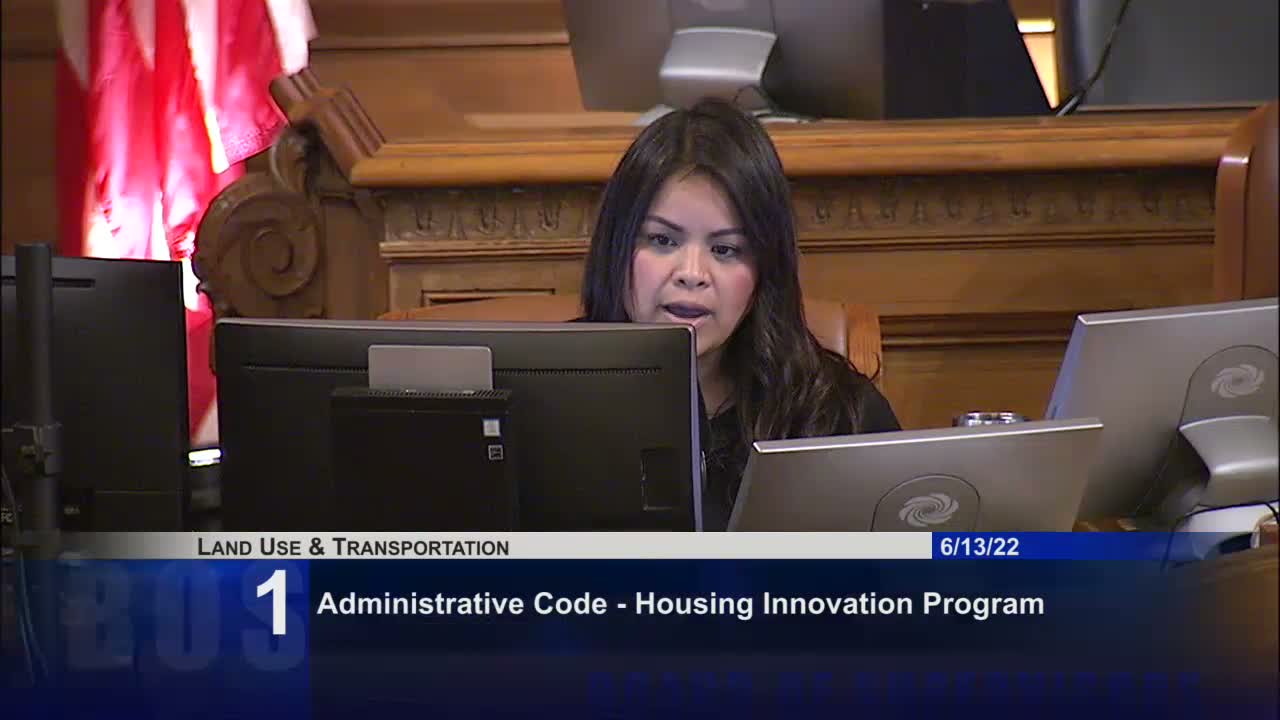
The Land Use and Transportation Committee advanced an ordinance that would amend the planning code and administrative code to permit the Mayor’s Office of Housing and Community Development (MOHCD) to collect penalties and use proceeds in the Affordable Housing Enforcement Fund to support enforcement activities.
Sheila Nicholas (MOHCD) introduced the item and said the ordinance makes no substantive policy change to enforcement standards but addresses back‑office administration: MOHCD would be able to bill for time and materials and receive penalty proceeds, which staff said would help the office expand enforcement capacity and reduce delays that arise when cases are routed between MOHCD and the Planning Department.
Jackie Tso, MOHCD’s homeownership and below‑market‑rate compliance manager, summarized the office’s enforcement history: over about 13 years MOHCD identified roughly 153 compliance cases that surfaced at marketing and occupancy stages, and approximately 70% of those cases involved homeowners violating deed restrictions or declarations of restriction. MOHCD said it already works with the City Attorney on civil penalties and that the proposed ordinance clarifies administrative responsibilities and supports MOHCD’s technical role in homeowner compliance cases.
Supervisors asked whether MOHCD had staffing and how the MOU between Planning and MOHCD would allocate leads. Staff replied MOHCD has existing monitoring staff and enforcement experience but needs additional resources; the MOU is intended to spell out which agency leads particular case types and allow flexibility for novel cases. With that discussion the committee voted to move the ordinance forward with a positive recommendation (three ayes recorded). Staff said MOHCD will seek to assess fee proceeds before making staffing additions.
What happens next: The ordinance will be transmitted with the committee’s recommendation; implementation will depend in part on collected penalties and budget decisions for enforcement staffing.