Get Full Government Meeting Transcripts, Videos, & Alerts Forever!
Get email alerts on the Local Budget topic
No spam. Unsubscribe anytime.
Budget committee accepts most analyst recommendations, splits on public-safety cuts
Summary
The Board of Supervisors— Budget and Finance Committee approved the bulk of the budget analyst—s recommendations for FY 2013— and 2014—, but voted separately on contested public-safety items including San Francisco Housing Authority overtime and a disputed District Attorney reduction; the Controller warned of state-level realignment cuts that will reduce public-health revenue.
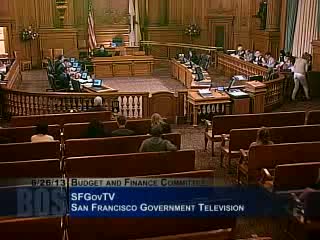
The San Francisco Board of Supervisors— Budget and Finance Committee on June 26 approved most recommendations by the Budget and Legislative Analyst for the mayor—s proposed two-year budget while reserving several contested public-safety items for separate votes. Chair Supervisor Mark Farrell led the committee through department presentations and motions that advanced multiple items to the full Board.
The committee accepted budget-analyst recommendations for the Health Service System, Department of Children, Youth and Their Families, the Department of Public Health and several other departments after officials said they had reached agreement with analysts. Treasurer Jose Cisneros and multiple department directors told the committee they would accept recommended adjustments.
Public-safety items drew the most sustained debate. The Sheriff—s office told supervisors it is planning a Hall of Justice replacement, not an expansion, and that the replacement would reduce overall jail capacity by roughly 30% while addressing unsafe conditions in Jails 3 and 4. "We're talking about reducing by 30%," the Sheriff said, describing an effort to replace aging facilities with smaller, more rehabilitative space.
The committee also took up a $1,016,195 recommended reduction to overtime funding for the San Francisco Housing Authority (SFHA) detail. Severn Campbell of the Budget and Legislative Analyst—s Office said the recommended reduction is based on audit findings and that the office found "no evidence that the two hours of overtime every day in any way enhance the program" compared with regular 10-hour shift scheduling. Police department leaders defended the housing detail as a community-policing assignment and argued the overtime provides scheduling flexibility and capacity during spikes in violence; the chief described recent incidents in which housing officers were first responders.
The committee moved the SFHA overtime recommendation into a separate roll-call vote while approving the remainder of the police budget adjustments.
Another contested item involved the District Attorney's Office. The office objected to an analyst-recommended $270,000 reduction, saying it would equate to losing the equivalent of two entry-level attorneys and could leave the office short of funds if staff turnover occurs. After a roll-call vote on the full analyst recommendation failed, supervisors approved a substitute cut of $100,000 in FY13/14 and $100,000 in FY14/15 — an amount the DA indicated the office was willing to accept.
Controller Ben Rosenfield delivered a substantive fiscal warning tied to the state budget. He told the committee the state—s adopted budget set aside implementation costs for the Affordable Care Act that reduce county realignment revenue by formula; Rosenfield said the first-year effect translates to roughly a $17,000,000 reduction in the realignment revenue available to the Department of Public Health and that the second-year impact could be significantly larger. "That is a revenue weakness versus the budget that's before you," Rosenfield said, urging the committee to hold reserves to offset the risk.
Other actions: the committee approved a fire-department reclassification that reallocated salary funds to overtime to close fiscal-year 2012— spending gaps, and advanced multiple budget items to the full Board for final action. Several items — notably the proposed suspension of budget-stabilization deposits — were continued for further discussion.
The committee recessed multiple times during the long docket and set follow-up meetings and roll-call votes for the remaining contested items.