Get Full Government Meeting Transcripts, Videos, & Alerts Forever!
Get email alerts on the Data Transparency topic
No spam. Unsubscribe anytime.
Court and Sheriff outline new public dashboards as supervisors seek more granular access
Summary
The Superior Court and the Sheriff's Office described recent and planned public dashboards and portals for criminal-case and custody data; supervisors asked about legal limits, searchable booking-level data and resources needed to expand DataSF datasets.
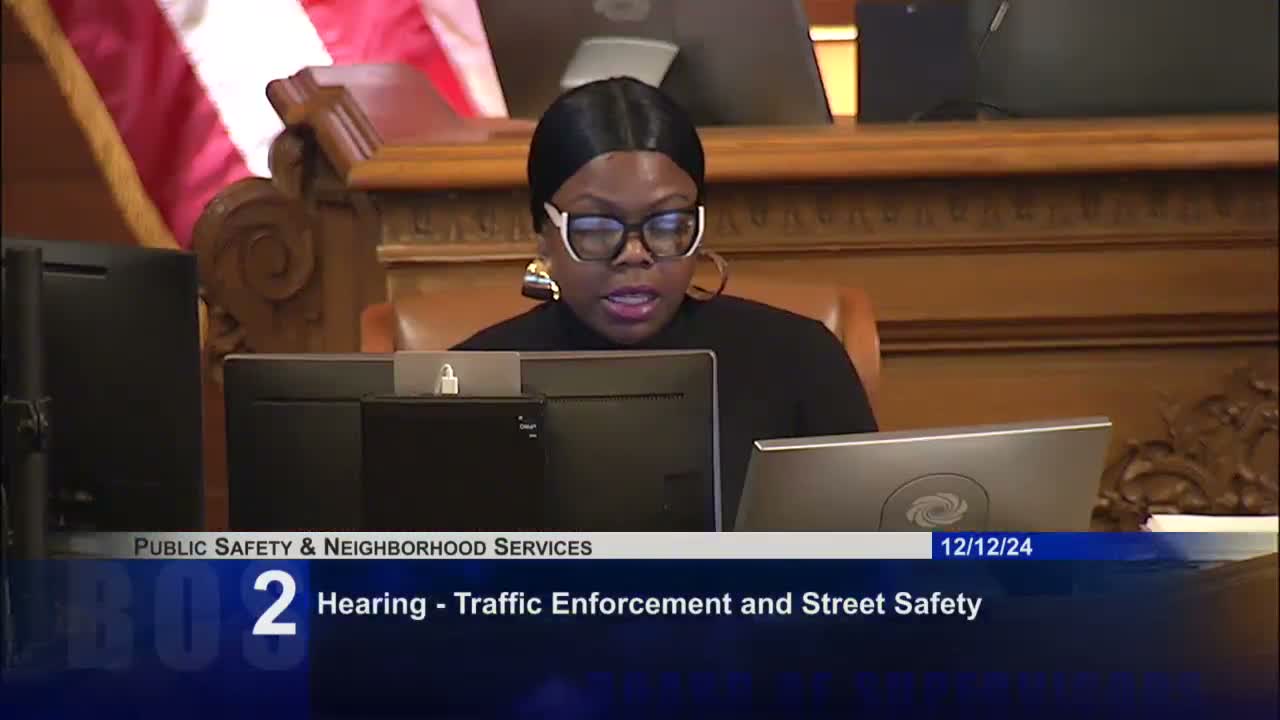
At a Dec. 14 hearing, the Superior Court and the San Francisco Sheriff's Office presented new public data tools and plans to expand online access to criminal-case and custody information while noting statutory limits on disclosure.
Brandon Riley and Michael Corriere of the San Francisco Superior Court described a three-phase effort: the criminal case information portal (launched April 2024) providing calendars, register of actions and an index; a criminal case data dashboard that updates daily and went live last month; and plans for electronic criminal-records requests and on-site kiosks targeted for spring 2025. Corriere said the dashboard provides aggregate, real-time indicators such as filings, clearance rates and dispositions and allows adjustable date ranges for analysis.
Corriere cautioned the committee about legal limits on sharing summary criminal offender information, referencing "13 300 PC" as read in the presentation and California Rules of Court Section 2.507 as controlling what can be posted. "We tailored the criminal portal to make sure that it adheres strictly to those limitations," Corriere said, and stressed that the dashboard was designed to publish aggregate statistics rather than case-level offender records.
Tara Moriarty and Lucas Jennings presented the Sheriff's Office custody dashboard, inmate-locator tool and historical jail-population data (records intact to 2010), noting those datasets are de-identified to protect incarcerated persons' privacy. Jennings described partnerships with DataSF and external research partners, and the office said a $5 million MacArthur Foundation grant will enable additional public data transfers and visualization.
Supervisors sought more granular booking- and charge-level data and asked about search capabilities; the Sheriff's Office said adding booking data is planned but must be balanced against re-identification risks, technical constraints and legal requirements. Both the court and the Sheriff's Office cited staffing and legacy systems as budgetary and logistical constraints to expanding online records.
Vice Chair Guardio and other supervisors praised the steps toward transparency and moved to file the hearing. The committee voted to file the hearing record.
The court said it will continue to refine the dashboard and pursue kiosks and online records-request functionality; the Sheriff's Office said it will expand DataSF datasets as system upgrades and privacy reviews permit.