Get Full Government Meeting Transcripts, Videos, & Alerts Forever!
Get email alerts on the Traffic Enforcement topic
No spam. Unsubscribe anytime.
Supervisors press SFPD for clearer traffic-enforcement targets as fatalities rise
Summary
Supervisors heard a broad SFPD presentation on traffic enforcement and a 2025 plan that reported a rise to roughly 13,000 citations in 2024 but also an increase in traffic fatalities; members pressed for measurable targets, department-wide prioritization and better cross-agency data linking to evaluate outcomes.
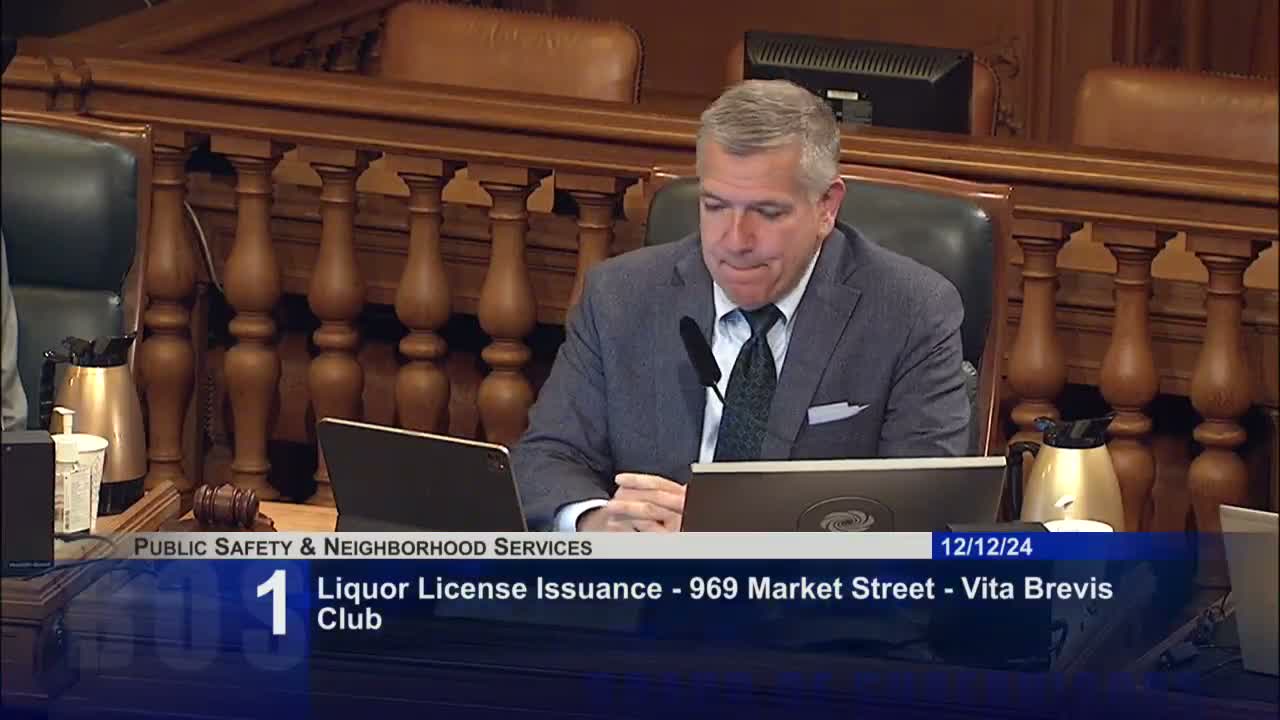
Supervisor Rafael Mandelmann led a Dec. 14 committee hearing that probed SFPD's traffic enforcement strategy for 2025 after Commander Jones of the SFPD Traffic Company reported a sharp rise in citations for 2024 alongside a troubling increase in traffic fatalities.
Commander Jones told the Public Safety and Neighborhood Services Committee that SFPD issued 12,467 citations through October 2024, with preliminary November figures placing the year near 13,000, compared with just over 5,000 citations in all of 2023. "We are definitely on the rise," Jones said, and credited a defined traffic enforcement plan and targeted operations for the increase.
At the same time, Jones said 42 traffic fatalities had occurred in 2024 and that pedestrians accounted for 25 of those deaths. "This is one of the deadliest, if not the deadliest traffic fatality year in the last decade," Jones told supervisors, and he said SFPD will collaborate more closely with the Department of Public Health to study which crashes are preventable.
Mandelmann said the presentation showed progress but stressed the city lacks clear, measurable enforcement goals. "I don't feel like the plan identifies an actual goal or an appropriate level of enforcement," he said, urging targets that would let the city measure whether enforcement restores deterrence and street safety.
Commander Jones outlined the 2025 plan's core strategies: data-driven partnerships with SFMTA and DPH, high-visibility enforcement (enforcement plus publicity), directed enforcement and the continued use of enforcement "waves" (two days a week, two hours per day every three weeks). He said the traffic company has conducted 50 wave operations since May and 44 directed-enforcement operations this year.
Jones also described technology and staffing needs: SFPD is expanding use of LIDAR, electronic citation systems, StarChase GPS projectiles and drones for sideshow enforcement; he said mounting radar and LIDAR to motorcycles would require mounts (~$200 each) and additional handheld devices (about $1,000 each) and that outfitting ~30 bikes would be necessary. He said new motorcycles cost about $78,000 each and the department has not bought new bikes since 2016.
Supervisors pressed for clarity about staffing figures, noting slides that listed 43 people assigned to the traffic company and investigations unit but that far fewer ride motorcycles on any given day. Jones clarified the 43 figure is an all-inclusive count and outlined a "solo response team" training effort to expand the number of officers capable of riding motorcycles to supplement the traffic company.
Board members and public speakers, including Jody Maderas of Walk San Francisco, praised local station improvements (Mission, Richmond, Tenderloin) and urged departmental prioritization citywide. Public commenters suggested increased automated enforcement and infrastructure fixes from SFMTA to complement police enforcement.
Mandelmann asked the committee to continue the hearing to the call of the chair to review first-quarter 2025 data, to confer with department leadership about prioritization, and to discuss concrete, legally permissible targets. The committee voted to continue the item; supervisors said they expect follow-up conversations with departmental leadership and the Department of Public Health to assess whether enforcement strategies are reducing fatalities and serious injuries.
The committee did not adopt numerical quotas; Commander Jones cautioned that any performance targets must avoid illegal quotas while still providing meaningful benchmarks.