Get Full Government Meeting Transcripts, Videos, & Alerts Forever!
Get email alerts on the Public Power topic
No spam. Unsubscribe anytime.
Supervisors and SFPUC press PG&E over requirements that city says have delayed projects and added millions
Summary
A committee hearing highlighted 68 city projects affected by PG&E equipment and tariff requirements, with SFPUC estimating about $19 million in added costs over three years. PG&E said its filings clarify safety and wholesale/retail distinctions; FERC has suspended a termination of unmetered service, allowing five months for settlement talks.
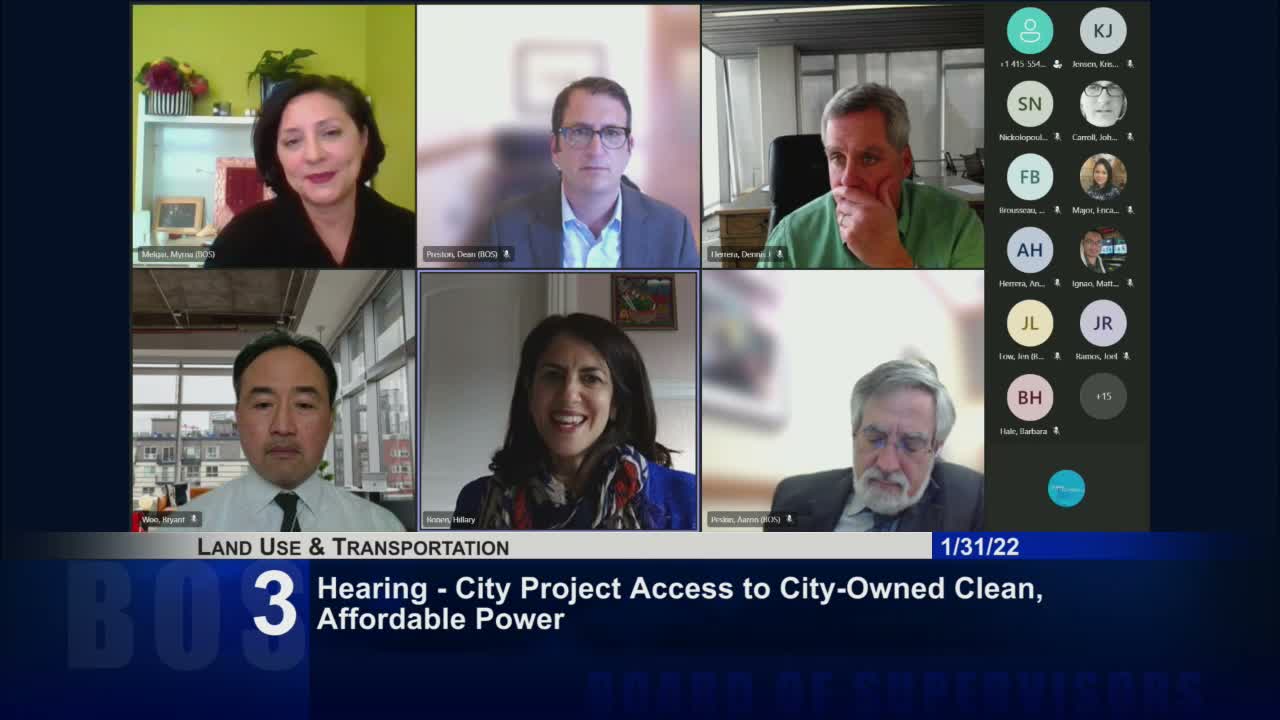
Supervisors, SFPUC officials and city department leaders held a prolonged hearing on PG&Es distribution equipment requirements and their impacts on city projects, from affordable housing to parks, pools, traffic signals and Muni electrification.
Sponsor Supervisor Hillary Ronan framed the dispute as a pattern of PG&E imposing large and costly equipment requirements on projects that the city says need only secondary connections. "PG and E has been requiring San Francisco to install expensive large equipment to power projects that don't require large amounts of energy," Ronan said, urging scrutiny of what she called anti-competitive behavior.
SFPUC General Manager Dennis Herrera described 68 active city projects where PG&E has demanded oversized primary switchgear or other requirements and said the city has documented nearly $19,000,000 in extra costs tied to redesigns, added equipment, delay and revenue loss over several years. He noted a recent D.C. Circuit decision remanding FERC orders and criticizing lack of sufficient explanation about alleged safety justifications.
Barbara Hale, SFPUCs assistant general manager for power, outlined how PG&E's April 2021 tariff filing would, if implemented as proposed, eliminate many unmetered secondary connections (streetlights, traffic signals, bus shelters and other low, predictable loads) and could require substantial primary equipment installations across the city at very high cost.
City agencies gave specific examples: Rec and Park said a primary switchgear requirement could consume space the size of a one-bedroom apartment in a park; SFMTA said delays already threaten its bus-electrification chargers and earlier projects experienced 8—2-month delays in PG&E service agreements. The MTA warned that charging infrastructure for an all-electric fleet would require substantial power upgrades and long lead times.
PG&E Regional Vice President Aaron Johnson said the utility's priorities are safety, reliability and clear standards, and that the company has filed tariff changes to make rules consistent across its service territory. "We will be more successful if we work together," Johnson said, emphasizing safety and wholesale-vs-retail distinctions in the dispute.
Supervisors repeatedly pressed PG&E for concrete safety justifications for requiring large primary equipment for small predictable loads; PG&E said the D.C. Circuit remand addressed FERC's written explanations and urged more complete administrative record-making rather than reversing precedent. FERC issued a suspension of PG&Es notice of termination for unmetered load and called for settlement discussions, giving the parties five months before further proceedings.
Public commenters at the hearing urged municipalization of distribution assets, stronger city action, and prioritized restoration of streetlights in dark corridors. The committee voted to continue the hearing to the call of the chair to allow further negotiation and follow-up with PG&E and city departments.