Get Full Government Meeting Transcripts, Videos, & Alerts Forever!
Get email alerts on the Transit Agreements topic
No spam. Unsubscribe anytime.
Supervisors OK amended feeder and FastPass deals with BART after analysts add 5% floor
Summary
The Budget & Finance Committee recommended two retroactive agreements between San Francisco and BART—one paying Muni for feeder service and one buying BART capacity for FastPass riders—after the budget analyst won committee support for a 5% floor on decreases in annual payments; a BART director urged reexamination of cross‑subsidies.
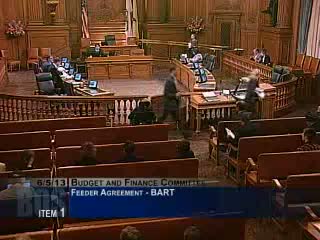
Supervisor Mark Farrell chaired a Budget & Finance Committee meeting June 5 where the panel recommended two retroactive transit agreements between the City and County of San Francisco and the Bay Area Rapid Transit District (BART).
Ed Ryskin, director of the Municipal Transportation Agency, told the committee the feeder agreement compensates Muni for feeder trips into the BART system, and the FastPass agreement lets San Francisco buy BART capacity along heavily traveled corridors so riders can reach downtown more quickly. "These agreements are good for transit in the Bay Area, and certainly for Muni," Ryskin said.
The Budget and Legislative Analyst recommended amending the feeder agreement to include a floor limiting annual decreases in payments to 5 percent. Analyst Mr. Rose said that without such a cap, payments would otherwise escalate about 6 percent annually and total roughly $33.3 million from BART to SFMTA over the agreement term. The committee adopted that amendment and approved both items as amended.
Zachary Mallett, who identified himself as the District 7 director on the BART board, urged the supervisors not to approve the agreements without further review. "I believe it is bad policy—cross subsidies," Mallett said, arguing that the benefits concentrate in parts of San Francisco while costs are borne by many other Muni riders.
Ryskin responded that BART leadership and staff supported the agreements and that analysts examined scenarios of what riders would do without the agreements. He said some riders would likely shift to Muni, which would strain service and harm transit use overall. "The people who were staying with BART would be paying a lot more," he said, arguing the agreements help reduce congestion and encourage transit ridership.
The committee voted to move the amended resolutions forward to the full Board of Supervisors for final action.
Next steps: the items will appear on the Board of Supervisors agenda on June 11 unless otherwise noted.