Get Full Government Meeting Transcripts, Videos, & Alerts Forever!
Get email alerts on the Police Labor Mou topic
No spam. Unsubscribe anytime.
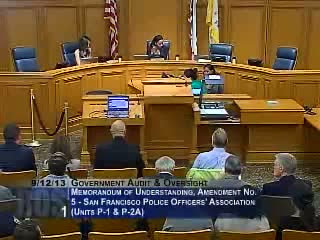
Committee forwards police‑officer contract amendments after HR says lower start rates will boost recruitment
Summary
The GAO Committee voted unanimously to send two proposed MOUs with the Police Officers Association to the full Board. City HR said the agreements lower starting wages for new recruits by about 10%, allow a 50‑person academy class in October and are expected to yield net savings in the first three years before modest COLA increases.
San Francisco — The Board of Supervisors’ Government Audit and Oversight Committee on Monday voted without objection to forward two ordinances implementing Amendment 5 to memoranda of understanding with the San Francisco Police Officers Association (Units P1/P2 and P2B) to the full Board for consideration.
Martin Gran of the Department of Human Resources’ Employee Relations Division told the committee the agreements lower starting pay for incoming recruits by about 10%, a change he said will let the city “aggressively start staffing” with a class of roughly 50 recruits in early October and plans for three classes over the next 12 months. Gran said savings are projected in the first three years of the MOU and the contracts extend through 2018, after which modest cost‑of‑living adjustments would begin (1% in 2015–16, 2% in 2016–17 and 2% in 2017–18).
Chair Malia Cohen and committee members asked whether lateral transfers would see pay changes. Steve Ponder, the city’s compensation manager, said lateral hires who enter as full, functioning officers generally come in at a corresponding step roughly comparable to what they earned in their prior jurisdictions—"they wouldn't go up or down," he said.
The presentation reviewed bargaining history: negotiators reached a tentative agreement over the summer, the association membership initially voted it down, and the parties made targeted changes (including adjustments to a sick‑leave cash‑out provision) before bringing the final agreement back to the Board.
Public comment on the items was limited. One member of the public urged that labor items be heard in Budget and Finance rather than GAO; Deputy City Attorney John Gibner replied that Board rules permit GAO to consider labor agreements.
The committee’s action was procedural: members agreed to send a committee report on items 1 and 2 to the full Board for its September 17 meeting. The committee record shows the motion passed "without objection." The full Board will consider the ordinances and any formal vote at that meeting.
What’s next: The MOUs will appear on the Board of Supervisors’ agenda; any final adoption and impacts to the city’s budget will be recorded in the Board’s vote and in subsequent Controller analyses.