Get Full Government Meeting Transcripts, Videos, & Alerts Forever!
Get email alerts on the Public Properties topic
No spam. Unsubscribe anytime.
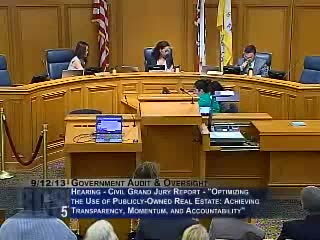
Grand jury urges public property database and code cleanup; city and school district outline next steps
Summary
A civil grand jury called for a consolidated public property map and legislative updates to Chapter 23A to better manage surplus and underused city and school district real estate. Mayor's Office said an integrated mapping system is in beta with full implementation targeted for Q1 2014; the School District outlined recent sales, leases and a proposed $235 million Ruth Asawa School of the Arts project.
The civil grand jury presented a report to the Government Audit & Oversight Committee on Sept. 3 urging improved transparency and active management of city and school district real estate. The jury recommended a consolidated web‑based property information map and database, periodic review and cleanup of Chapter 23A of the Administrative Code to broaden permissible uses of surplus property, and institutional changes to charge specific entities with reviewing underused assets.
Tom Walker and Paul Cheng summarized examples of fallow or underused properties and recommended a consolidated public database to make property status and planning information available to the public. The Mayor's Office (Antonio Guerra) and Director of Real Estate John O'Keefe described progress: two mapping systems already exist and an integrated mapping system was in beta testing in July with full implementation expected in the first quarter of 2014. O'Keefe demonstrated map features intended to show ownership, planning documents, permit and complaint status and a contact department for each property.
School district Chief Facility Officer David Golden told the committee the district maintains a public capital plan and a property inventory; he described recent actions that repurposed or disposed of properties (examples cited in the record included a sale for $11.1 million and reuse of former school buildings). Golden and others said the district is an independent state agency constrained by Education Code rules; the district rejected a blanket policy to force surplus sales because of fluid educational needs but said it is actively pursuing reuses and will continue collaboration with the Mayor's Office of Housing where appropriate.
Grand jury members and supervisors discussed the long‑standing challenge of repurposing assets such as 135 Van Ness and 170 Fell; Paul Cheng noted a preliminary project cost estimate of about $235,000,000 to convert historic buildings into a new Ruth Asawa School of the Arts campus. The committee agreed to legislative cleanup and additional reporting and directed further analysis as needed. For one item the committee continued the hearing to the call of the chair and forwarded other resolutions to the full Board; motions passed unanimously.
Next steps: the Mayor's Office and Real Estate will implement the integrated mapping system to meet the public access commitment in Q1 2014; proposed amendments to Chapter 23A will be drafted for Board consideration; the committee will receive follow‑up analysis as directed.