Get Full Government Meeting Transcripts, Videos, & Alerts Forever!
Get email alerts on the Public Housing topic
No spam. Unsubscribe anytime.
Board reviews audit finding SF Housing Authority troubled, residents detail repairs and wait-list failures
Summary
The Board of Supervisors heard a Budget & Legislative Analyst audit that identified governance, financial and operational failures at the San Francisco Housing Authority and dozens of residents testified about mold, broken heating, long waits and vacant units. SFHA leaders described steps underway and said HUD technical assistance begins in July.
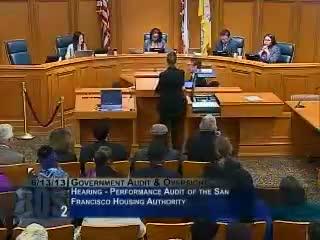
The San Francisco Board of Supervisors’ committee on June 25 heard a performance audit from the Budget & Legislative Analyst that found long-standing financial and management problems at the San Francisco Housing Authority (SFHA), while residents delivered more than two hours of public testimony cataloging maintenance failures, safety concerns and stale wait lists.
Severin Campbell of the Budget & Legislative Analyst Office introduced Amanda Guma, who summarized the audit’s main findings. The office concluded that HUD had designated SFHA a “troubled agency” in December 2012 and that weak internal financial controls and management practices had worsened the authority’s fiscal health. “Since 02/2009, the Housing Authority has not hired a Chief Financial Officer and has not developed a long term financial plan,” Guma said, and noted budget shortfalls of $4.0 million in 2011 and $2.6 million in 2012. The audit reported the authority faced a multi-million-dollar shortfall in 2013 and cited HUD’s projection that SFHA could run out of cash between May and July 2013.
Guma highlighted operational problems that contribute to the financial strain: governance lapses, unstable procurement (the procurement function moved five times in three years), insufficient staffing analyses, chronic Section 8 performance problems and a large maintenance backlog. The audit noted occupancy was 93 percent versus HUD’s 98 percent standard and said about 276 units were vacant an average of 195.5 days, costing the authority subsidy and rent revenue.
Barbara Smith, SFHA’s acting executive director, told the committee the agency welcomed HUD technical assistance beginning in July and described steps the commission had taken since being reconstituted in February. Smith said the commission had re-established finance and personnel committees, begun staff training and centralized procurement. She also said SFHA was preparing a disposition application to sell the 440 Turk commercial property and intended to use proceeds for one-time capital needs.
Joaquin Torres, president of the SFHA commission, and Phil Arnold, chair of the commission’s Finance and Personnel Committee, said the commission had negotiated concessions with three unions representing about 90 percent of the authority’s labor force and was pursuing a new “maintenance mechanic” classification that HUD identified as a condition for releasing withheld funds. Arnold described the fiscal picture bluntly: “When we were appointed in February, we knew that the Housing Authority was a troubled agency, but we didn’t know how troubled…we found very shortly that there was a $7,000,000 current year deficit,” he said.
During public comment more than 40 residents and advocates recounted problems that match the audit’s findings: repeated mold and mildew, broken heating and plumbing, bed-bug and rodent infestations, months-long delays for emergency transfers, lost work orders and inaccessible complaint processes. Tenants, legal-aid attorneys and homeless-service providers pressed the authority to update and reopen the Section 8 and public-housing wait lists; speakers described vacant units sitting empty while families remain homeless or in shelters.
“I came to talk about problems with staff responsiveness specifically on Section 8, because this goes to the credibility of the agency,” said Bob Planthold, one of the speakers during the public comment period. Several nonprofit attorneys urged the authority not to shift shortfalls onto tenants through late fees and repair charges; one advocate said SFHA had 50 active eviction cases and had laid off in-house counsel.
SFHA officials told the committee they had already reduced the projected deficit through position eliminations, renegotiated service payments and other savings, and that HUD’s assistance and the maintenance mechanic classification would be critical to unlocking $1.0 million–$1.5 million in federal funds. Commissioners said key vacancies would be filled and a five-year financial plan developed in coordination with HUD technical assistance.
Committee members did not take a final vote on the audit item; the hearing was held for review and public comment. Supervisors and SFHA officials said the next steps include HUD’s technical assistance, continued negotiations with craft unions over the maintenance classification, and implementation of the audit’s recommendations. The committee then moved to other agenda items.
The committee record includes extensive resident testimony; staff said SFHA and city offices would follow up with complainants and that commissioners and staff are working on both short-term cash-flow fixes and longer-term governance and staffing reforms.