Get Full Government Meeting Transcripts, Videos, & Alerts Forever!
Get email alerts on the Mental Health Sf topic
No spam. Unsubscribe anytime.
Rules Committee hears DPH report on Mental Health SF implementation, identifies bed and funding gaps
Summary
At a Dec. 9 hearing, DPH Behavioral Health Services reported on Mental Health SF accomplishments—about 400 new residential beds, 24/7 Street Crisis Response teams, and an Office of Coordinated Care—but warned of funding volatility (Prop C revenues 30–40% below plan), staffing shortages and ongoing bed needs; the committee 'heard and filed' the report.
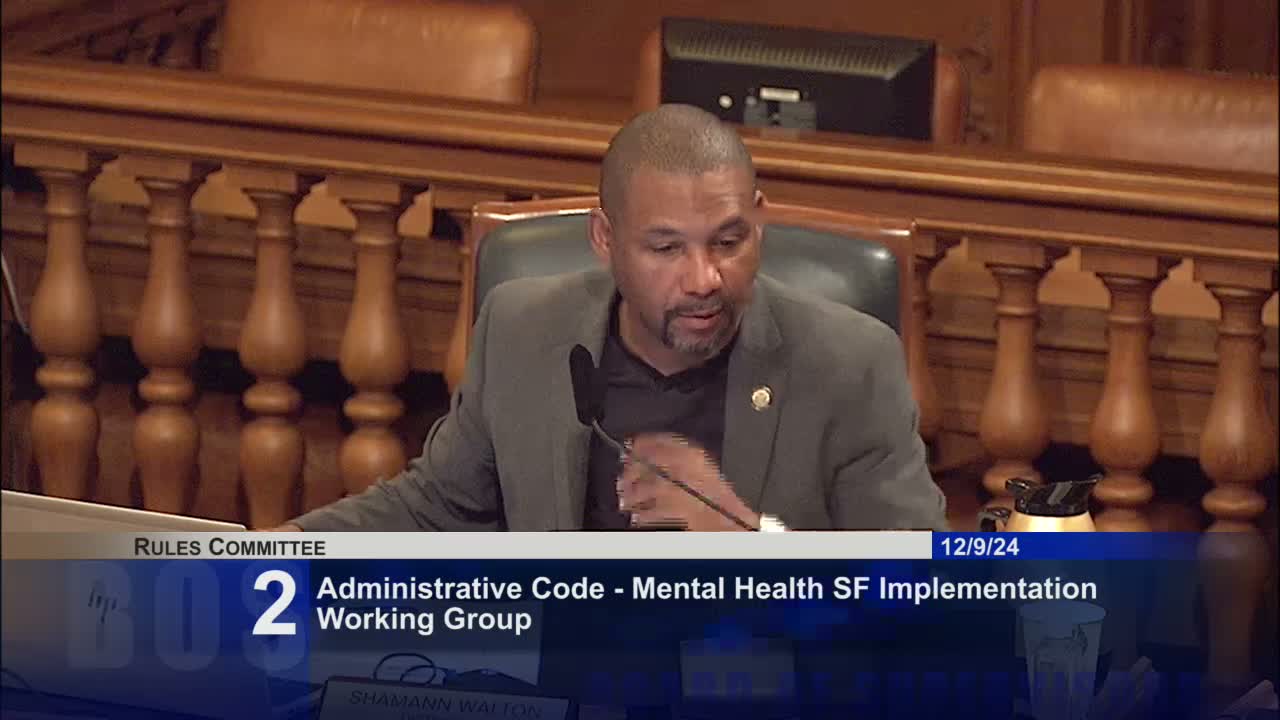
The Rules Committee on Dec. 9 held a substantive hearing on Mental Health SF implementation and heard a multi-part report from Department of Public Health Behavioral Health Services (DPH BHS). The presentation outlined accomplishments, quantified remaining bed needs and described operational and financing constraints.
A DPH presenter described Mental Health SF’s core components — the Office of Coordinated Care (OCC), the Street Crisis Response Team (SCRT) and expanded residential care — and said the city has added roughly 400 new residential care and treatment beds conceived under Mental Health SF. DPH described a centralized access model (including expanded Behavioral Health Access Center hours) and said OCC served more than 8,500 distinct individuals in fiscal year 2023–24, hired more than 45 clinicians and managers, and recorded more than 9,000 neighborhood engagements through the Best Neighborhoods teams.
DPH gave bed-need estimates based on recent modeling: approximately 50 additional mental health residential treatment beds, 55–95 locked sub-acute beds (mental health rehabilitation centers or LSAT), 20–40 behaviorally complex therapeutic placements, and 8–10 additional residential withdrawal management beds. The department said it has obtained more than $70 million in state funding to support behavioral health infrastructure projects and has applied for Prop 1 bond funding for several projects; Prop 1’s behavioral-health allocation was described in committee testimony as part of a $6.4 billion statewide bond with about $4.4 billion for behavioral health projects.
DPH also described performance increases tied to service expansions: a 32% increase in methadone treatment admissions, a 46% increase in buprenorphine prescriptions filled at the DPH pharmacy, and a 35% increase in residential treatment admissions in FY23–24 versus the prior fiscal year.
The presenter warned that revenue from the Prop C business tax that funds Mental Health SF is volatile and currently about 30–40% below DPH’s spending plan, requiring one-time reserves to sustain programming in the near and medium term. Data integration challenges also remain: DPH said federal confidentiality rules (42 CFR Part 2) require partitioning substance-use-treatment records, limiting full integration into a single EPIC electronic health record without patient consent.
Supervisors praised the program’s progress, thanked DPH staff and pressed for continued focus on staffing, site acquisition and sustainable funding. Chair Walton moved that the hearing be 'heard and filed'; the committee voted in favor and the motion passed without objection.