Get Full Government Meeting Transcripts, Videos, & Alerts Forever!
Get email alerts on the Youth Services And Early Care topic
No spam. Unsubscribe anytime.
First 5 and DCYF defend spending priorities as dozens of community speakers urge restoration of youth program funding
Summary
First 5 and DCYF presented FY2013–15 budgets and RFP outcomes; First 5 outlined Prop H/Prop 10 reserves and Race to the Top grants while DCYF defended RFP choices. Dozens of community groups and youth urged restoration of cuts to neighborhood youth programs and asked for transparent award data by grantee, ZIP code and demographic.
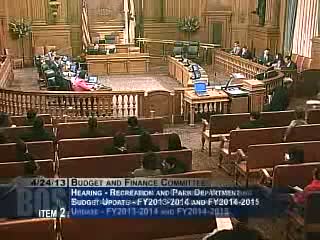
First 5 San Francisco and the Department of Children, Youth and Their Families (DCYF) briefed the Board’s Budget & Finance Committee on April 24 on proposed FY2013–15 allocations and recent RFP awards. Laura Klumach, First 5’s executive director, said First 5 will draw on Prop H and Prop 10 funds and reserves to sustain preschool and family resource investments; she reported Prop H allocation at about $17.7 million and warned First 5’s Prop 10 revenue is declining toward an estimated $5.6 million next year.
Klumach described a Race to the Top Early Learning Challenge federal grant (about $1.3 million over three years) and a sustainability plan that uses reserves to backfill state cuts, including $2.8 million annually from Prop H to cover state preschool reimbursement reductions — a measure First 5 said would protect full‑day preschool for roughly 4,000 children.
DCYF Director Maria Hsu presented the department’s total oversight (including school transfer passthroughs) and said DCYF manages roughly $78.19 million of direct program funds excluding SFUSD transfers. Hsu described the department’s allocation plan, monitoring, fiscal oversight and an RFP round for out‑of‑school time and youth leadership (YLEAD) that increased allocations for comprehensive afterschool and youth workforce. Hsu said the department intends to post more data online and offered to provide district‑level grantee funding and participant ZIP‑code breakdowns.
Much of the meeting turned to public comment. More than 50 speakers — community‑based organizations, parents, youth and service providers — urged the Board to restore DCYF funding for specific programs the RFP process reduced or eliminated. Speakers described what they said were sudden eliminations of long‑running neighborhood programs (examples named included Youth Empowering Soma, Girls 2000, Oasis for Girls, Lyric school‑based programs, Youth First, and many others) and warned reductions would cut services for high‑risk youth, reduce employment and training opportunities, and eliminate critical supports for children with special needs.
Supervisors asked DCYF for detailed transparency: funding amounts requested versus awarded, whether an award was a new program or previously funded, participant demographics (race/ethnicity, age), ZIP‑code participation, average daily attendance and an independent review. Supervisor Marr and others asked whether the Controller’s Office might conduct an independent analysis similar to a three‑year‑old report; Hsu and DCYF staff signaled willingness to share data and said they are discussing further review and web publication of awards and metrics.
Deputy City Attorney John Giffner reminded the public and supervisors of Charter §2.114, which limits the Board’s ability to direct departments to fund specific grantees: the Board sets budget priorities but departments award contracts and grants administratively.
The hearing closed with supervisors asking DCYF to return with additional district‑level and demographic data and with staff committing to share further details and consider independent analyses of allocation impacts.