Get Full Government Meeting Transcripts, Videos, & Alerts Forever!
Get email alerts on the Small Business Recovery topic
No spam. Unsubscribe anytime.
Committee hears 17‑part Small Business Recovery Act; opponents urge pause for equity review
Summary
The Mayor’s Small Business Recovery Act would streamline permitting, expand expedited conditional‑use processes (including limited ‘‘small formula retail’’), allow rooftop and other outdoor uses under limits, and expand ADU and accessory use rules. Proponents said the package reduces red tape and helps lifelines for restaurants and entertainment; critics—especially in low‑income and cultural districts—urged dividing the omnibus bill and adding an equity‑first community review.
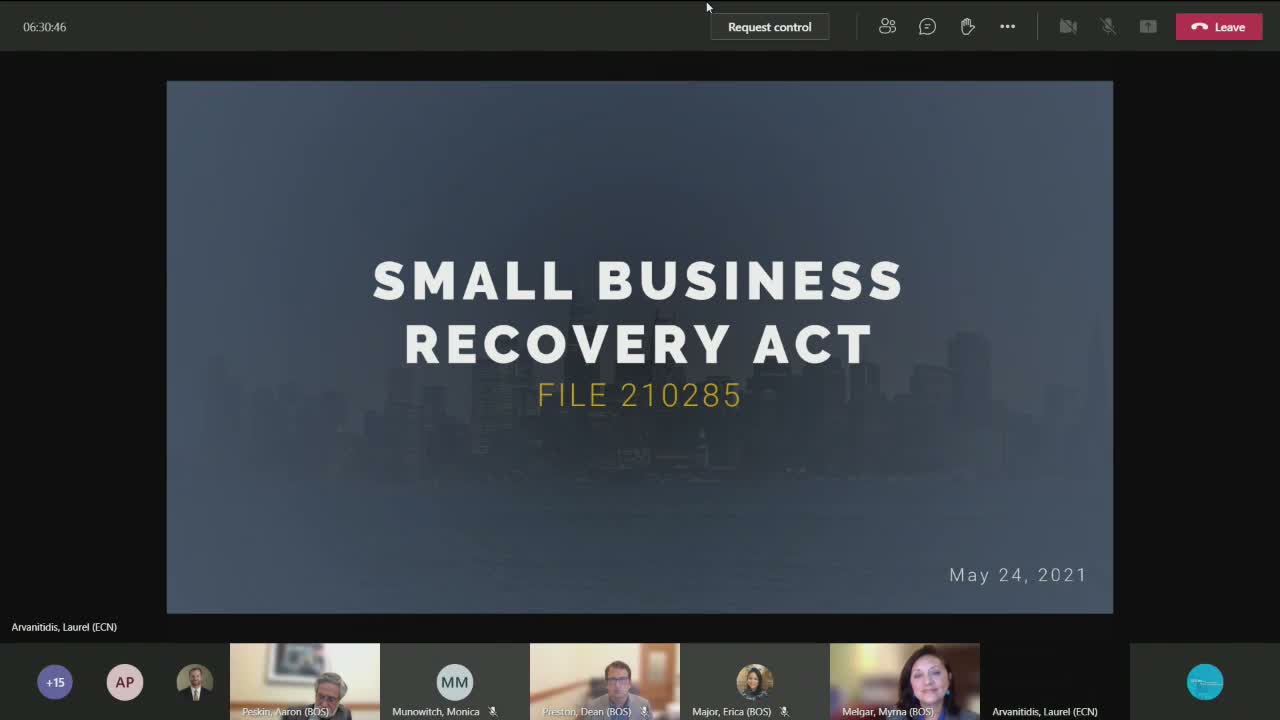
The committee heard a lengthy presentation from the Mayor’s Office (Laurel Arvantidis, OEWD) on a 17‑part ordinance labeled the Small Business Recovery Act. The package seeks to accelerate and simplify land‑use and permit processes for neighborhood businesses, expand expedited conditional‑use hearings to additional uses (bars, nighttime entertainment, certain formula retail under a small‑store threshold), allow greater flexibility for rooftop and outdoor uses, permit expanded catering and accessory uses, and adjust historic‑resource noticing and other technical rules.
Key provisions described by OEWD: - A citywide 30‑day processing guarantee for principally permitted ground‑floor uses (to reduce weeks of delay). - Expanded expedited conditional‑use timelines (90 days) for specified uses and a new “small formula retail” category (fewer than 20 locations worldwide) eligible for expedited processing. - Permit streamlining including consolidation of several tenant‑use categories to reduce change‑of‑use paperwork and a proposal to allow certain rooftop uses subject to hours and service conditions. - A provision to allow conversion of deeper ground‑floor commercial space in mixed‑use buildings to accessory dwelling units (ADUs) where minimum commercial depth remains; OEWD framed this as a way to adapt oversize retail footprints while producing housing. - New avenues for entertainment and pop‑up activation, including limited live performance permit adjustments and removal of the cap on one‑time amplified sound permits for neighborhood events.
Public reaction: The package drew polarized public comment. Business groups, downtown stakeholders and hospitality associations urged passage, saying the code is a barrier to reopening, re‑employment and reinvestment. Entertainment representatives and cultural organizations welcomed language to ease live performance permitting. By contrast, the Race and Equity in All Planning (REP) coalition, neighborhood associations and many callers from the Mission and other low‑income, BIPOC neighborhoods asked that the omnibus be broken up: they argued the bill would accelerate gentrification, reduce neighborhood notice and community protections, and could benefit landlords and developers more than legacy mom‑and‑pop businesses. They called for neighborhood‑specific tailoring, additional funding and guarantees for immigrant‑owned small businesses, and preservation of public process on sensitive items (notably ADU conversions, rooftop nightlife and formula‑retail relaxations).
Committee action: Supervisor Peskin circulated a set of amendments seeking to preserve the abandonment rule, retain Historic Preservation Commission review for minor alterations, limit or remove rooftop and ADU changes and restore stronger conditional‑use findings and neighbor notice in several contexts. The committee adopted a package approach: it accepted a set of Peskin amendments and continued remaining matters to the call of the chair (and duplicated the file so that unresolved sections can be returned later for further work and consultation). The committee did not advance the whole omnibus to the Board today; staff and members agreed additional targeted consultation is needed, notably with cultural districts and equity stakeholders.
Why it matters: The proposal is a wide‑ranging rewrite of zoning and administrative practice that could shorten opening timelines and reduce permit costs for many businesses, but it also touches on culturally sensitive areas—neighborhood notice, street character, rooftop/nighttime uses and conversions of commercial space into housing—that advocacy groups say require tailored solutions and stronger equity protections.
Next steps: The committee approved several amendments, duplicated the file and continued outstanding matters for additional staff work and community consultation. Members asked staff for neighborhood‑level impact analyses, clear equity protections for cultural districts (Mission), and guardrails that prevent displacement or speculative conversion of long‑standing commercial spaces.