Get Full Government Meeting Transcripts, Videos, & Alerts Forever!
Get email alerts on the Car Free JFK topic
No spam. Unsubscribe anytime.
Committee adopts amendments to beach‑to‑bay car‑free resolution, urges study of ADA access, transit and managed entry
Summary
Supervisor Connie Chan’s "beach‑to‑bay" resolution to preserve and extend car‑free connections through Golden Gate Park was amended to clarify equity provisions, add ZIP‑code targets for garage access and to instruct SFMTA and Rec & Park to study managed access at Eighth Avenue to allow vehicles actively transporting seniors and people with limited mobility; the amendment passed and the item was forwarded as a committee report.
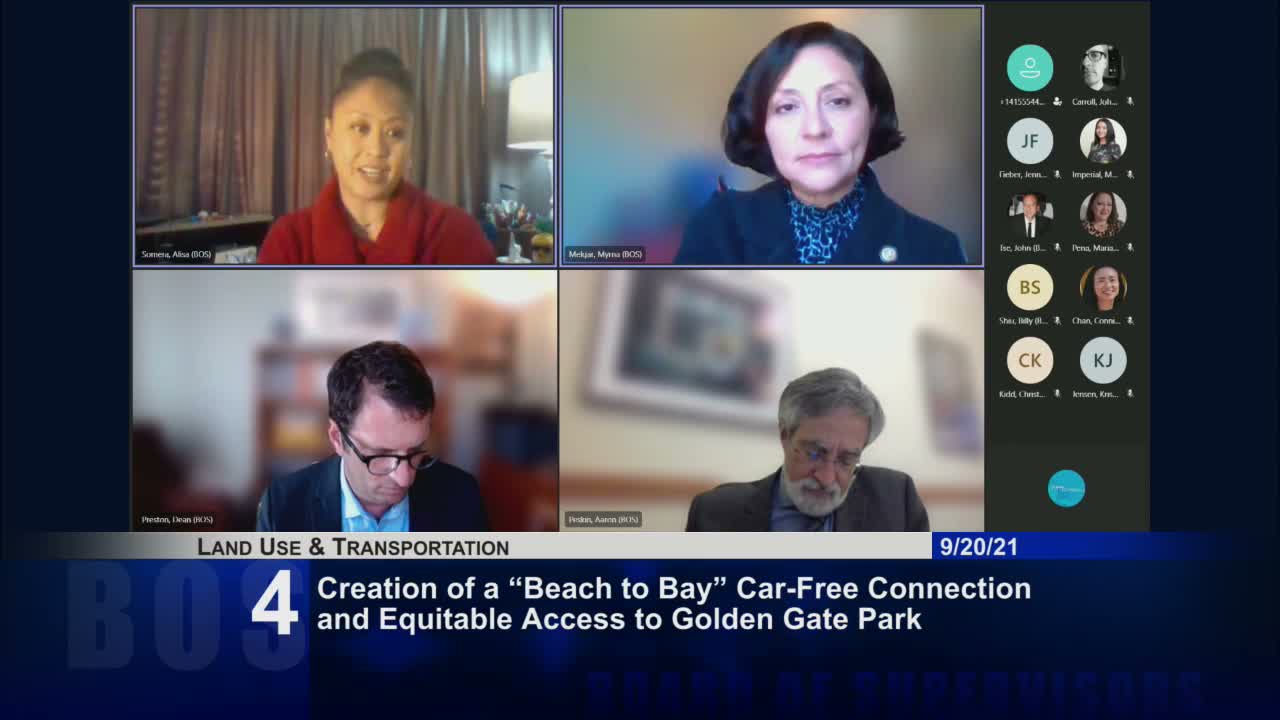
The Land Use & Transportation Committee on Sept. 20 adopted amendments to a resolution authored by Supervisor Connie Chan that seeks a continuous car‑free connection across Golden Gate Park and directs agencies to improve equitable access for underserved neighborhoods.
What the resolution would do: The measure frames a "beach‑to‑bay" car‑free corridor that builds on pandemic‑era closures and asks the San Francisco Municipal Transportation Agency (SFMTA) and Recreation & Park Department to study improvements including wayfinding, park shuttle stops, weekend transit directly to the Music Concourse, use and pricing of the Music Concourse garage to increase ADA and low‑income access, and restoration of key transit connections such as the 21 Hayes into the park.
Amendments and operational scope: Supervisor Chan read a set of clarifying amendments inserted into the record that (1) reference prior Board resolutions, (2) add specific ZIP codes (including 94124, 94112, 94108, 94134 and 94133) for targeted outreach and garage access, (3) expand the language on park maps/wayfinding to include shuttle and garage signage, and (4) replace language about "allowing vehicles" with a directive to "develop options for considering managed access at Eighth Avenue and Fulton Streets to allow for vehicles actively transporting seniors, people with disabilities, and visitors with limited mobility." Chan emphasized the resolution retains the "no cut‑through" intent from earlier prop and resolutions.
Public reaction: During a lengthy public‑comment period dozens of callers and organizations supported the car‑free intent but many urged stronger language to prohibit private‑vehicle cut‑throughs at Eighth Avenue, asking that access be reserved for Muni buses, paratransit, taxis and drop‑offs tied to ADA needs. Representatives of Kidsafe SF, the San Francisco Bicycle Coalition, Walk San Francisco, the Vision Zero coalition and transit advocates all pressed the committee to prioritize transit reliability (notably the Muni 44 route) and to use the garage to serve accessibility needs rather than reopening surface streets to private cars.
SFMTA response and implementation concerns: Sarah Jones, SFMTA’s planning director, told the committee that allowing certain vehicles to enter at Eighth Avenue while excluding others "would be very complicated" operationally and would likely require staffing at that location; SFMTA said it would pursue physical measures and public outreach as part of the study. Supervisors emphasized signage, outreach about the concourse garage entrance at Tenth Avenue, and further technical work by agencies.
Outcome: The committee voted to adopt Supervisor Chan’s amendments and to send the amended resolution as a committee report with a positive recommendation (Chan, Preston, Melgar — ayes). The resolution instructs Rec & Park and SFMTA to conduct public engagement and feasibility work; any permanent changes would require subsequent legislative or administrative action.
Next steps: SFMTA and Recreation & Park are to carry out the study, public outreach and develop concrete managed‑access options and parking/garage signage; supervisors indicated follow‑up legislation or administrative changes could follow the public process.