Get Full Government Meeting Transcripts, Videos, & Alerts Forever!
Get email alerts on the Shotspotter topic
No spam. Unsubscribe anytime.
Committee forwards ShotSpotter surveillance policy from DEM to full board
Summary
The Department of Emergency Management described ShotSpotter gunshot-detection deployment and audio-retention practices; the committee voted to forward the surveillance-technology policy to the full board and asked DEM to follow up with evidence on operational effectiveness.
SAN FRANCISCO — The Rules Committee on Sept. 9 advanced a Department of Emergency Management surveillance-technology policy for the ShotSpotter gunshot-detection system to the full Board of Supervisors and requested follow-up information on the system's effectiveness.
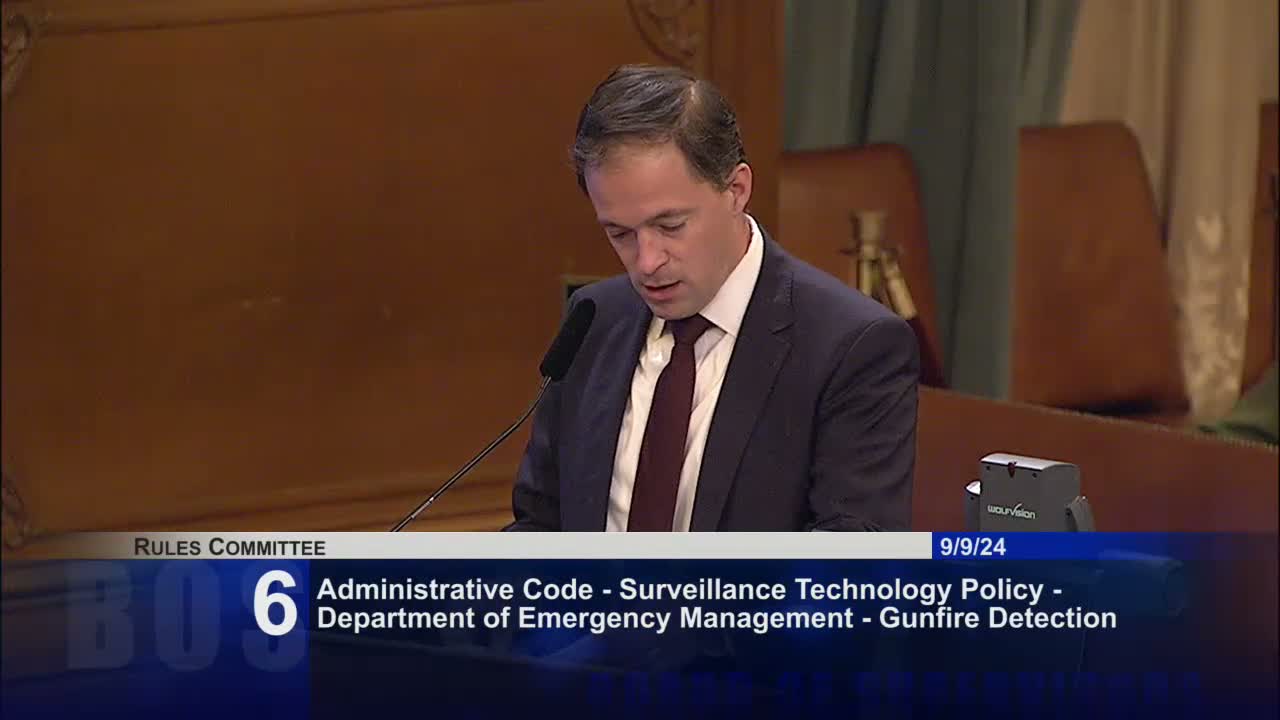
Robert Smuts, DEM deputy director overseeing the 911 center, said ShotSpotter uses about 20 sensors per square mile in areas where it operates. The vendor processes raw audio off-site and DEM receives a confirmed-event package that includes a one-second audio snippet before and after the detected shot; DEM retains that confirmed audio for one week. "The sound recorded by these sensors is accessible by the department for one week and one week only," Smuts said. He added that unconfirmed audio captured at vendor headquarters is purged after roughly 30 hours when no gunshot is detected.
Chair Walton asked whether ShotSpotter has demonstrably led to arrests or suspect identification. Smuts said he did not have hard data at the meeting but offered to obtain deployment and outcomes data and to consult with SFPD. With no public comment, the committee voted to forward the ordinance with a recommendation to the full board.
The forwarded policy will now be considered by the full Board of Supervisors; DEM said it would provide further data on deployments and any links to apprehensions or victim assistance.