Get Full Government Meeting Transcripts, Videos, & Alerts Forever!
Get email alerts on the Police Drone Policy topic
No spam. Unsubscribe anytime.
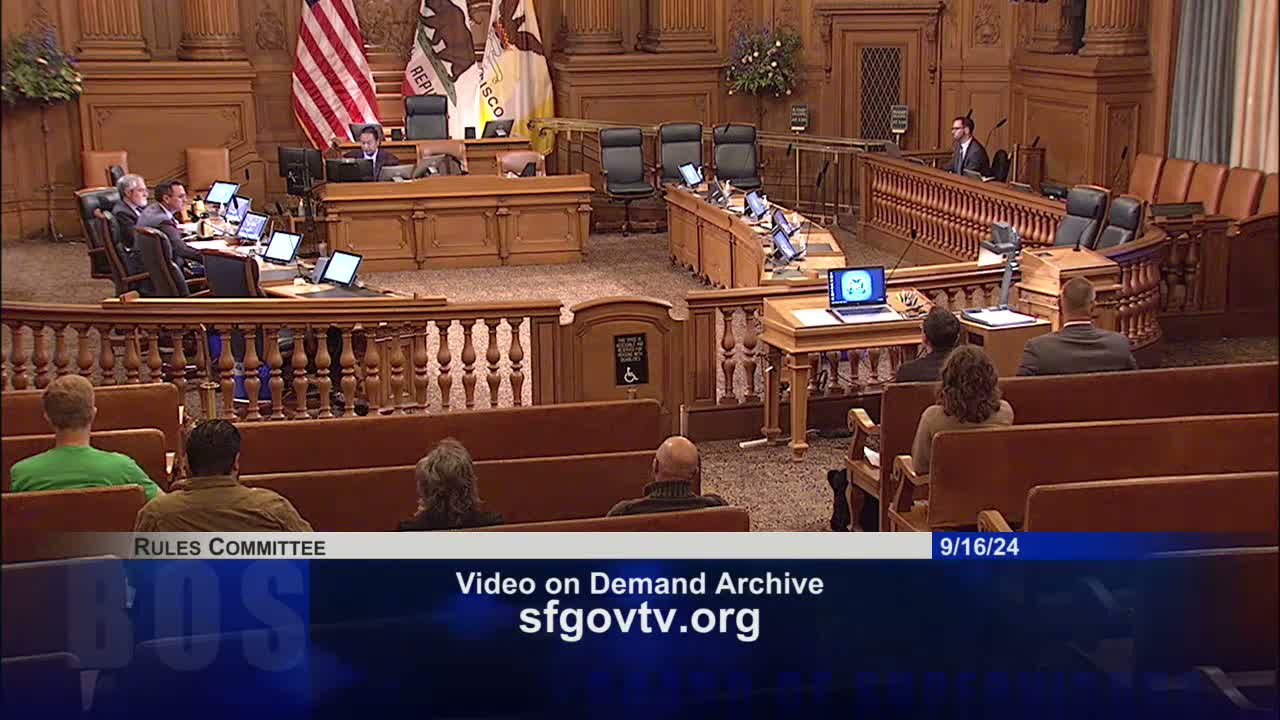
Rules Committee adopts amended SFPD drone-use policy and sends it to full board
Summary
The Rules Committee approved amendments to the San Francisco Police DepartmentUAS (drone) policy adding prohibitions on First Amendment infringements, weapons, and force usage, and added data-retention limits; the committee forwarded the item to the full Board of Supervisors with a positive recommendation.
The Rules Committee of the San Francisco Board of Supervisors voted Sept. 16 to accept amendments to the San Francisco Police Departments policy governing unassisted aerial systems (UAS), commonly called drones, and sent the item to the full board with a positive recommendation.
The committee accepted proposed prohibitions that, as read by a San Francisco Police Department representative, would bar department-owned UASs from being used to "infringe on the lawful exercise of rights protected by the First Amendment," from serving non-law-enforcement purposes, from being equipped with weapons, and from being used as a force option. The department representative also emphasized operational limits requiring operators to focus cameras only on mission-relevant areas and to "take reasonable precautions, such as turning imaging devices away to avoid inadvertently recording or transmitting images of areas where there is a reasonable expectation of privacy unless authorized by law." (San Francisco Police Department representative.)
The amendments add a data-retention protocol: digital media evidence (DME) without evidentiary value may be deleted within 30 days, while DME with evidentiary value would be retained for a minimum of 2.5 years "in accordance with federal and state laws and regulations," the department representative said. The representative cited San Francisco Administrative Code section 96.10.2 (subsection E) as a controlling local rule limiting retention of public footage and restricting access unless a captain or higher authorizes longer retention or access.
President Aaron Peskin said he appreciated the departments work with interested parties and indicated he was "prepared subject to public comment to make the amendments that Carl has laid out." Acting Chair Supervisor Asha Safaei thanked the department and requested a follow-up report in six to nine months on the number of operators hired and their deployment.
Public comment was mixed. H. Brown supported rapid operator training and cited disaster response benefits; another commenter, identifying as Jordan, said safeguards would not be adequate and urged rejection of the policy.
The committee voted to accept the amendments as read and to forward the item to the Board of Supervisors as a committee report with a positive recommendation (Member Aaron Peskin and Vice Chair Safaei voted aye; Supervisor Shamone Walton was excused). The item is scheduled to appear on the Board of Supervisors agenda on Sept. 24, 2024.