Get Full Government Meeting Transcripts, Videos, & Alerts Forever!
Get email alerts on the Pension Divestment topic
No spam. Unsubscribe anytime.
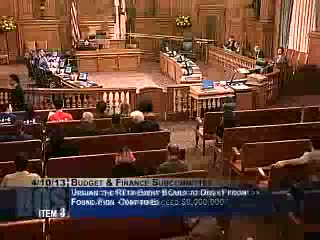
Board committee urges retirement system to explore fossil‑fuel divestment; forwards resolution after robust public comment
Summary
The Budget & Finance Subcommittee advanced a nonbinding resolution urging the San Francisco Employees Retirement System to cease new fossil‑fuel investments and pursue phased divestment within five years, and asked SFERS to provide additional detail on private‑equity exposure; the committee accepted amendments clarifying SFERS' fiduciary duties and potential investment‑return tradeoffs and forwarded the resolution to the full Board.
The Budget & Finance Subcommittee voted to forward to the full Board a nonbinding resolution urging the San Francisco Employees Retirement System (SFERS) to pursue a divestment strategy for publicly traded fossil‑fuel holdings. Supervisor John Avalos, the resolution’s sponsor, framed the measure as a policy response to both climate science and financial risk, saying the resolution would ask the retirement board to stop new fossil‑fuel investments and to divest over a five‑year period in a manner intended to be financially responsible.
Avalos cited reports and analysis that, he said, point to a risk that most fossil‑fuel reserves must remain unburned to prevent catastrophic warming and that valuations based on those reserves could be impaired by future regulations. He described the resolution as modeled on SFERS’ social‑investment policy and tied to local climate initiatives.
Jay Huish, SFERS’ executive director, presented the system’s social‑investment approach, explaining the policy’s three levels — shareholder voting, engagement, and, as a last resort, restricting or replacing holdings — and described the system’s public‑holdings profile. Huish told the committee SFERS’ public holdings in the named universe totaled roughly $528 million in market value across public equity and fixed‑income positions; he said private‑equity holdings are contractually constrained and not subject to the same screening and that staff would need a formal directive and analysis to evaluate a multiyear divestment plan.
Investment practitioners and academic analysts testified in favor of divestment or cautioned on implementation costs. Paul Soley of Aperio Group presented a quantitative study that, he said, shows excluding fossil‑fuel companies and rebalancing would increase absolute portfolio risk by an immaterial amount, citing tracking‑error estimates (an incremental risk on the order of 0.01 percent) and historical backtests that sometimes favored a carbon‑free portfolio.
A broad swath of public comment followed. Speakers — including students, local environmental groups, physicians, indigenous representatives, and investment managers — urged the Board to move the resolution forward, pressed SFERS for transparency on private‑equity fossil exposures, and called for reinvestment in renewable energy and local green jobs. Several speakers framed divestment as both a moral imperative and a financial protection against stranded‑asset risk.
Committee members pressed Huish on the scale and location of fossil‑fuel investments (public vs. private, commingled funds, benchmark indices used) and asked staff to provide more precise counts and valuations of private‑equity fossil exposures before the full Board hearing. Huish agreed to provide additional data.
Supervisors discussed and agreed to two clarifying amendments for full‑Board consideration: language acknowledging that the resolution does not supersede the retirement board’s fiduciary duties and a clause recognizing that divestment could affect investment returns and that the Board of Supervisors accepts those tradeoffs. With those amendments, the committee moved the resolution to the full Board for the April 23 meeting with a recommendation to advance, without opposition.
The full Board will receive the resolution and the requested SFERS follow‑up on portfolio exposures and implementation analysis prior to its hearing.