Get Full Government Meeting Transcripts, Videos, & Alerts Forever!
Get email alerts on the Public Safety topic
No spam. Unsubscribe anytime.
Fire chief warns mandatory overtime persists as hires lag; department eyes Medi‑Cal reimbursement for EMS
Summary
Fire Chief Hayes White told the Budget Committee that despite 48 new recruits the department still relies on mandatory overtime because retirements outpace hiring; restored ambulance exclusivity and pending Medi‑Cal reimbursement could add revenue for EMS staffing.
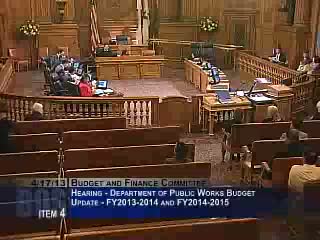
Fire Chief Hayes White told the Board’s Budget and Finance Committee that the department’s operating budget for FY2013-14 is roughly $332 million and that about 92% of that amount is for salary and benefits, leaving limited money for supplies, station upkeep and other needs.
Chief White described the continued effects of historically low staffing levels, saying the department is using a voluntary overtime list (WDO) but must fall back to mandatory overtime when volunteers are exhausted. “It's not something that I'm interested in doing,” he said, noting mandatory overtime strains personnel and families. He described a negotiated hard cap on individual overtime of 1,100 hours as a distribution measure, and previewed a supplemental request to reallocate approximately $4.1 million from salaries to overtime to comply with recent overtime legislation.
The chief highlighted recent hiring under the Mayor’s Public Safety plan — 48 new graduates — but warned that retirements (historically 60–80 per year) and other attrition mean hiring alone will take time to restore full staffing. He and supervisors urged accelerating academy classes where possible; Supervisor Breed and others said more frequent classes would reduce mandatory overtime and fatigue.
Chief White also discussed emergency medical services (EMS): the state restored San Francisco’s exclusive operating area (EOA) for 911 ambulance transports, but the department’s market share has fallen from around 90% to about 70% and must rise to at least 80% to conform with EOA language. He said recent state legislation enabling additional federal reimbursement for Medi‑Cal transports could generate an estimated $300–$350 per qualifying transport and that the department likely would reinvest any new revenue into EMS staffing and equipment.
Chief White reviewed capital and equipment items: the department has $3 million in grant funding for self-contained breathing apparatus replacement, about $1.3 million for defibrillators, five ambulances and 10 new fire engines on order (about a one-year build timeline), and multiple bond-driven station upgrades and the Mission Bay public safety building topping ceremony. He told supervisors the department will present a fuller overtime reallocation request at a subsequent meeting.
There were no public comments and the committee continued the item to the call of the chair.