Get Full Government Meeting Transcripts, Videos, & Alerts Forever!
Get email alerts on the Financial Exposure Libor topic
No spam. Unsubscribe anytime.
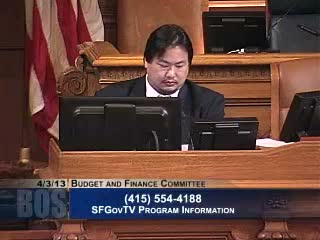
Supervisors hear staff briefings and public pleas to seek recovery after LIBOR manipulation
Summary
At an April 3 Budget & Finance Committee hearing, city staff described limited but tangible exposure to LIBOR manipulation across San Francisco portfolios while union and community speakers urged the city to pursue recoveries and renegotiations; the committee continued the item to the call of the chair for further analysis.
The San Francisco Budget & Finance Committee heard an extended briefing and forceful public testimony Wednesday on whether the city lost money because of alleged manipulation of the London Interbank Offered Rate, known as LIBOR, and what legal or contractual steps the city should take.
"Whether we lost $10,000 or $10,000,000 as a city, we owe it to the taxpayers to aggressively pursue this issue to hold the banks accountable," Supervisor John Avalos said as he opened the hearing that drew staff presentations and more than an hour of public comment.
Why it matters: LIBOR has been a reference rate for a vast array of financial products worldwide. City financial managers and outside advisers told the committee that most San Francisco obligations are fixed-rate and therefore not affected, but some variable-rate facilities and interest-rate swaps tied to LIBOR could have been exposed. At the end of the hearing the committee voted to continue the matter to the call of the chair while the Budget Analyst and City Attorney's offices analyze next steps.
What staff told the committee - Nadia Sasse, director of the Office of Public Finance, summarized how LIBOR is set and said the city's initial review suggests San Francisco's managers were relatively conservative; she estimated variable-rate indebtedness in the city's portfolio at about $129 million (roughly 5 percent of $2.9 billion of outstanding debt) and stressed that determining any loss requires careful, instrument-by-instrument analysis.
- Kevin Cohn, Assistant Deputy Director for Capital Finance at San Francisco International Airport, said the airport once hedged about $790 million with LIBOR-indexed swaps and currently has about $483 million in swaps. He offered sensitivity illustrations: if LIBOR had been manipulated by 10 basis points for one year, the airport's cost impact could be about $371,000; 20 basis points about $723,000; 30 basis points about $1.1 million. Cohn said a precise allocation would need daily-reset analysis and consultant work.
- Jay Huish of the San Francisco Employees' Retirement System told the committee the retirement trust had swap positions during parts of 2007–2009 and that a back‑of‑the‑envelope result would be about $200,000 in net losses per 10 basis points for the period examined; he said the retirement board typically participates in class recoveries rather than filing a separate lawsuit unless fiduciary review supports it.
- Greg Cato of the Treasurer's Office said LIBOR-linked instruments were a small share (about 5 percent) of the pooled fund during the period in question, produced no principal losses, and that active trading limited yield impact to under three basis points (he estimated the dollar impact at under $1 million over the period discussed).
Legal context: Deputy City Attorney Tom Lakritz told the committee the city attorney's office is reviewing recent federal decisions, including a dismissal of certain antitrust claims in the Baltimore litigation, and is assessing statute-of-limitations and overlap with existing suits (Baltimore; San Mateo and San Diego counties; Freddie Mac). He said the office had not yet decided whether San Francisco would join a class action or pursue independent litigation.
Public pressure to act: Dozens of public speakers — labor union representatives, retirees and community advocates — urged immediate, assertive action. "We need to get that money back for our communities as well," said Bahar Tulu of SEIU, summarizing repeated testimony that recoveries should be pursued even if some gains must be netted against losses.
Points of disagreement in the hearing: Community speakers argued existing swap contracts (notably at the airport) have cost the city substantially and urged renegotiation. Staff described how swaps had saved the airport money historically and cautioned that contracts are long term and cannot be renegotiated unilaterally; however, several speakers pointed to examples elsewhere where renegotiation occurred.
Committee action and next steps: Supervisors asked the Budget Analyst's office to prepare a scope of work and requested a follow-up briefing by the city attorney. The committee moved to continue the LIBOR item to the call of the chair for more detailed analysis and modelling; the motion carried without recorded opposition.
What to watch for next: The committee expects the Budget Analyst and City Attorney to return with a clearer estimate of potential exposure, legal options (including joining or opting out of classes), and recommendations on whether to seek renegotiations, settlements or litigation.