Get Full Government Meeting Transcripts, Videos, & Alerts Forever!
Get email alerts on the Pension Investments topic
No spam. Unsubscribe anytime.
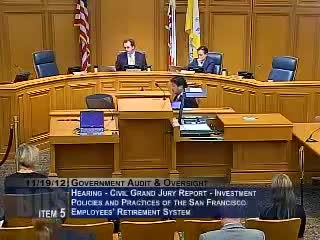
Civil grand jury urges pension board to reassess investment risk and assumed returns; trustees defend long‑term strategy
Summary
A civil grand jury report criticized the San Francisco Employees' Retirement System for underfunding and for relying on what the jury called an unrealistically high assumed investment return, recommending an independent review and lower assumed returns. SFERS staff and trustees defended the board's long‑term approach, explained actuarial and asset‑liability processes, and said the board is already phasing down the assumption to 7.5%.
The civil grand jury presented a report arguing the San Francisco Employees' Retirement System (SFERS) remains underfunded and urged the retirement board to prioritize preservation of principal, review its assumed investment return methodology and analyze alternative, lower‑volatility strategies. Grand jury members said the fund's assumed return (7.66% through 2013,then 7.5%) contributes to an actuarial view that understates pension liabilities and warned that higher assumed returns can reduce the City's estimated liabilities and shift costs to taxpayers.
"The jury believes the board prioritizes achieving high returns over safeguarding principal," a grand jury spokesperson said, summarizing the panel's concern that a long‑term push for higher returns leaves the plan more exposed to market shocks. The panel recommended a public task force and independent failure analysis of investment decisions that preceded the 2008–2009 market losses.
SFERS Executive Director Jay Huish and trustees responded at length. Huish said the system conducts regular asset‑liability modeling and actuarial valuation work, the board has publicly debated and is phasing the long‑term assumption down to 7.5% over several years, and staff monitor portfolio risk and manager performance at least quarterly. "These are long‑standing processes," Huish said, adding that the board consults recognized actuarial and investment advisers and reports in public meetings.
Trustees emphasized the fund's long horizon for liabilities and the need to accept some degree of risk to meet benefit obligations, noting private‑equity and alternative allocations historically supported higher long‑term performance. The jury and the board did agree on some facts: the fund suffered large market‑value declines in 2008–2009 and the citymust increase contributions to restore full funding over time.
Committee members said they would take parts of the grand jury report under advisement while also noting the complexity of pension funding, actuarial assumptions and the legal authority of the retirement board to set investment policy. The committee tabled one grand jury item for further consideration and asked that Board and staff provide additional material comparing the cityfund's performance and assumptions to outside studies cited by the jury.