Get Full Government Meeting Transcripts, Videos, & Alerts Forever!
Get email alerts on the Arts Commission Grand Jury topic
No spam. Unsubscribe anytime.
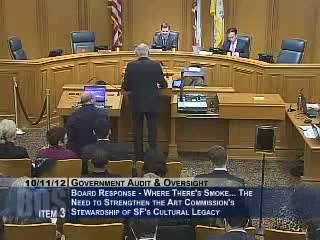
Board committee hears civil grand jury critique of Arts Commission, adopts amended response
Summary
The Government Audit and Oversight Committee received a civil grand jury report that found governance gaps, an incomplete inventory and insufficient maintenance for the city—s civic art collection and urged changes to the Arts Commission; the committee accepted a resolution responding to the report and asked the Arts Commission director to return in six months with implementation details.
The Government Audit and Oversight Committee on Tuesday took testimony on a civil grand jury report that concluded San Francisco—s Arts Commission has governance and stewardship problems and recommended a range of changes, from a charter amendment to new funding for the civic art collection.
Mort Raphael, chair of the grand jury—s investigative committee, told supervisors the jury—s review found an Arts Commission that often prioritizes the interests of arts organizations over broader public stewardship and has repeatedly failed to carry out charter duties. "We recommend that a charter amendment be made," Raphael said, urging either an expansion of the commission—s membership or creation of advisory bodies to broaden community oversight.
The grand jury described the city—s civic art collection as a roughly $90,000,000 asset of about 4,000 objects whose inventory and maintenance have fallen behind. Raphael said the commission—s maintenance allocation is limited (the report cites a $75,000 maintenance line) and recommended a sustained inventory effort and increased maintenance funding.
Arts Commission Director Tom Delaney, who said he began in the job on Jan. 9, thanked the jury and described steps the commission is taking. "We are committed and are actually in the process of beginning a very comprehensive strategic planning and community engagement process," Delaney said, noting a planned 10-year capital plan and recent private fundraising including a $60,000 grant from the Keith Haring Foundation to restore a public sculpture. He said the commission has closed several prior controller recommendations and has hired additional civic art staff to address inventory and conservation backlogs.
The grand jury also criticized a four-year contract between the Arts Commission and the San Francisco Symphony that directs a $2,000,000 municipal tax to the Symphony and returns 40% of proceeds to the commission. Raphael said that arrangement "appears to be at odds with the intent of the charter." Deputy City Attorney John Gibner told the committee his office has advised the Arts Commission that it can accept gifts from the Symphony under the charter and that the Arts Commission's use of those funds has been within its legal authority.
The committee—s exchange with staff and auditors covered how to fund long-term conservation needs, the appropriate home for maintenance dollars (capital budget versus operating), and whether to pursue charter changes. Supervisors debated competing priorities and budgetary constraints; several members said they would prefer to be ``honest'' about categorizing maintenance while also focusing on practical funding to ensure preservation.
After line-by-line discussion of findings and recommendations, the committee accepted a resolution responding to the grand jury report as amended, asked the Arts Commission director to return in six months with an evaluation of reform options, and recorded a mixture of agreements, partial agreements and requests for further analysis on specific recommendations.
What—s next: the committee forwarded the amended resolution without objection and directed staff and the Arts Commission to coordinate follow-up work and public MOUs for maintenance partnerships such as with Recreation and Park. The director was asked to report back in six months with an implementation plan and any proposals the commission recommends for structural change.