Get Full Government Meeting Transcripts, Videos, & Alerts Forever!
Get email alerts on the Climate Action topic
No spam. Unsubscribe anytime.
Supervisors update San Francisco’s Chapter 9, set tougher climate targets and require departmental roles
Summary
The Board of Supervisors’ Land Use & Transportation Committee amended Chapter 9 of the Environment Code to set more ambitious greenhouse‑gas targets, require a five‑year Climate Action Plan and a public monitoring dashboard, and assign departmental responsibilities for implementation. The committee approved edits increasing near‑term sector and consumption reductions and advanced the ordinance to the full Board as a committee report.
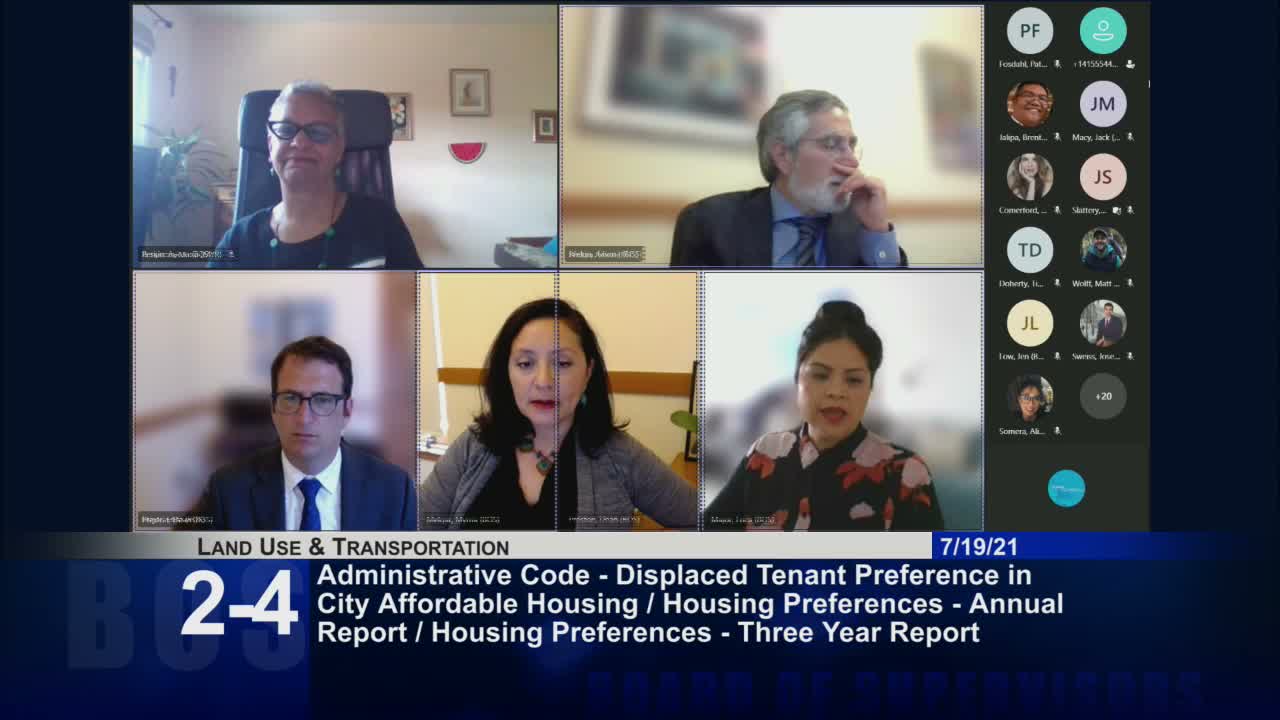
San Francisco — The Land Use & Transportation Committee voted July 19 to advance an updated Chapter 9 of the city’s Environment Code that sets new citywide climate targets, tightens planning and reporting timelines, and assigns roles across city departments to implement a forthcoming Climate Action Plan.
Cindy Comerford, program manager at the Department of the Environment, told the committee the ordinance modernizes Chapter 9 to reflect recent climate science and to unify departmental responsibilities. “Chapter 9 will serve as an opportunity to unify the city and city departments around the same climate goals,” Comerford said, adding the update creates a framework for a climate plan that staff aim to publish shortly after adoption.
Comerford described the ordinance’s goals as a mix of sector‑based and consumption‑based targets, a five‑year cadence for plan updates and a monitoring, evaluation and public‑dashboard requirement to track progress. The climate paper presented a range of policies — energy supply, building decarbonization, transportation, production and consumption — and emphasized equity, workforce transition and resilience.
Supervisors pressed the department on the specifics. Supervisor Peskin asked whether housing policy, affordability targets and streamlining language belonged in the Environment Code rather than planning or housing documents. Lisa Fisher of the Planning Department said housing work is being coordinated across agencies and that housing strategies in the Climate Action Plan support emissions reductions through compact infill near transit.
The committee also debated how fast the city should aim for net‑zero emissions. Comerford said staff analyzed more aggressive dates but concluded that accelerating net‑zero significantly would require large amounts of external funding and technical changes in buildings and transportation systems. “To get to these targets we will need political leadership, public support and funding,” she said.
After public testimony — including climate advocates urging still more ambitious targets and community members calling for strong equity safeguards — the committee accepted several technical and policy edits, including changes the deputy city attorney circulated as to form. At the meeting supervisors amended the draft’s numeric targets: the committee approved increasing the sector‑based reduction target to 70% by 2030, raising the consumption‑based reduction target to 50% by 2030, and moving the net‑zero target to 2040. (Those numbers reflect the committee’s approved amendments.)
Comerford said the Climate Action Plan will follow Chapter 9 and provide the implementation details and strategies — including transportation mode shares, electrification, and building decarbonization — that the ordinance itself does not prescribe.
What happens next: The committee recommended the amended ordinance to the full Board of Supervisors as a committee report. The department said it will publish the Climate Action Plan and a public dashboard to track progress once Chapter 9 is adopted.
Authorities: The proposal amends Chapter 9 of the San Francisco Environment Code and would require a Climate Action Plan that the department must update every five years.
Votes and procedural status: The committee approved the staff amendments and the numeric target amendments on roll calls and forwarded the ordinance to the full Board as a committee report.